Module 2 LLM’s Unit report – Yea I said it I’m PRO AI in College!!

AI reinforces ideas, not replace them

This week was an especially interesting week after reading the MIT report on generative AI in higher education. The study showed that, over a long period of time, students who relied on LLMs to do work for them had weaker EEG brain connectivity compared to the second group (Brain to LLM). Their EEG brain connectivity was much stronger due to their memory storage being stronger, as they actually applied themselves to understand the topic at hand. However, instead of looking at this as a bad thing, we can use this report to change generative AI for not only the betterment of the student but also people in the world. Students should use generative AI in their college studies, but in an ethical way. Instead of creating generative AI that spits out answers, there can be generative AI that guides students to the answer in the same way a tutor would. Nevertheless, there is an example of this already happening at Harvard University. They have an AI tutor embedded in a course called “CS50 Duck,” Harvard’s introductory course.

In order to embed generative AI into college academics, we have to do as it says in the MIT report: “redesign AI to guide instead of answer”. I wanted to use Harvard’s AI design model as my foundation to create something bigger, something that will not only help students with their work but also inform students on the importance of using AI responsibly to utilize fewer resources to negate the harm to the environment. “Brain connectivity systematically scaled down with the amount of external support”. Seeing this to be true in teh article, as well as when we did a sample experiment in class. In order to prevent that, I wanted to create an AI tool/app similar to CS50 Duck in Claude. When formatting my prompt, I made sure I followed the four steps to create an effective prompt to produce the best output. Follow the four most important rules when prompting AI, which are: ADD context and motivation, be clear and direct, use examples, structure the prompt, and give the model a role.

Building The Socratic Margin that an LLM’s behavior is mostly a design decision rather than a fixed property of the model, since the same system that will hand a student a finished essay will also refuse to if you build the refusal into the tool instead of politely asking the model for it. I learned that instructions alone are not a guardrail: my prompt tells the tutor never to write out the work, but the page itself also strips any worked-out block before it reaches the screen, and it is that second layer, not the first, that actually holds when a user pushes. As a maker, I found that my hardest decisions were pedagogical rather than technical, because deciding that the student and not the AI controls when the hints get stronger, and that the “climb a rung” button stays locked until the student has written something real, took far longer to reason through than any of the code did. On ethics and inclusion, I realized that a tutor that withholds answers is only fair if it meets students where they actually are, which is why the ladder changes its vocabulary by subject and by level instead of assuming every student arrives with the same preparation. In the larger digital ecosystem, this method of building a small, constrained, single-purpose AI tool works as a counterweight to general-purpose chatbots, and it suggests that the most valuable work in educational AI may be narrowing what a model is permitted to do rather than expanding it. Going forward, I would test the tool on other students instead of on myself, because I currently have no evidence that my hint ladder produces the “productive struggle” the MIT report calls for rather than simply a slower path to the same frustration.

Artifacts
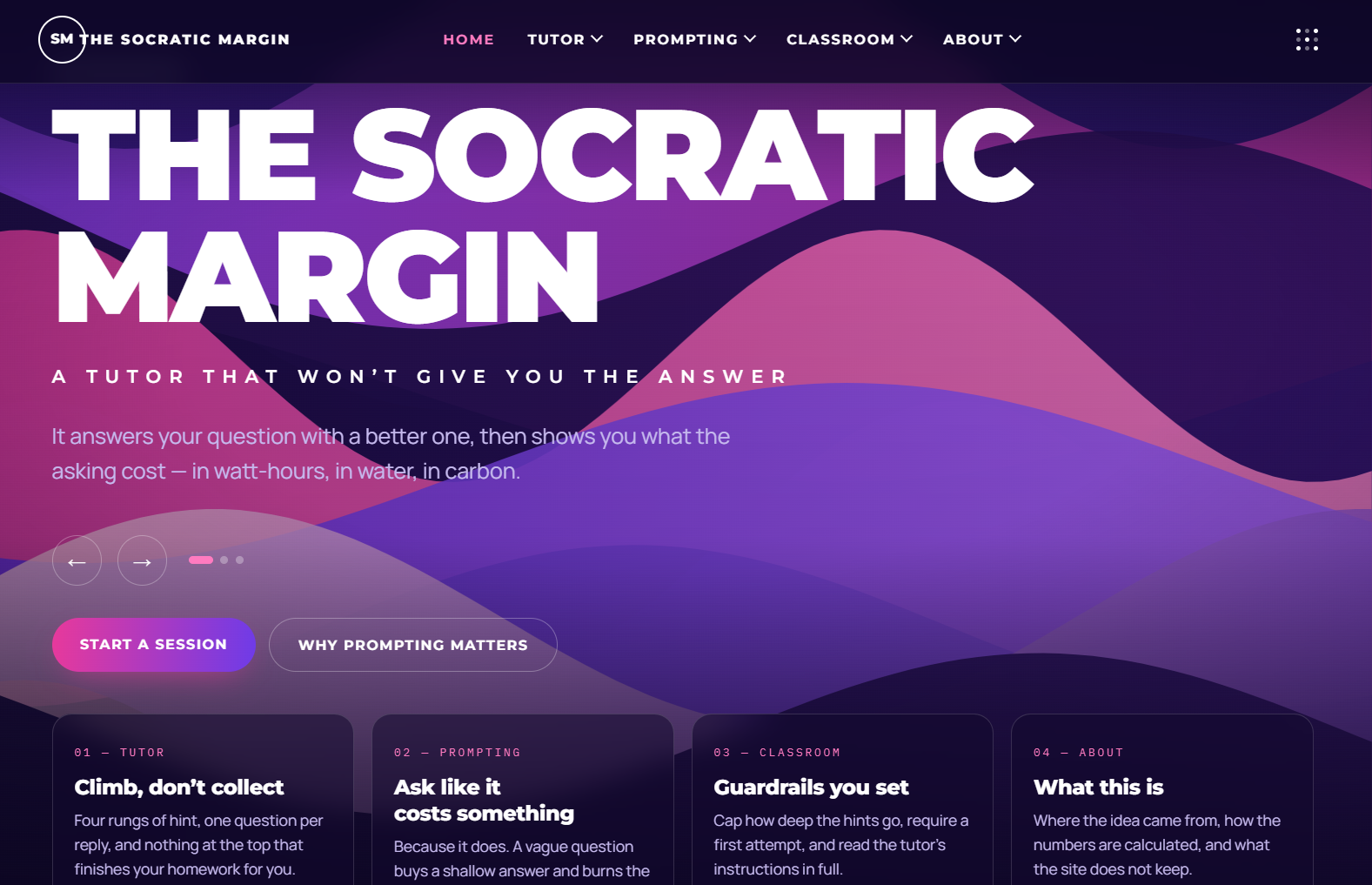
This helps with creating effective prompt to utilize less resources

There are two different artifacts that are being displayed here which are the Socratic Margin & my Build One now prompt agent

The Socratic Margin- This a website I created through the LLM Claude. This website lets you submit any academic material and asks you three questions. What you’re working on, what you tried, and where it stops making sense. Futhermore when you submit your content it breaks down what you dont understand step by step. This website also has a drop down tab to inform everyone on why prompting matter and the importance of prompting as well.

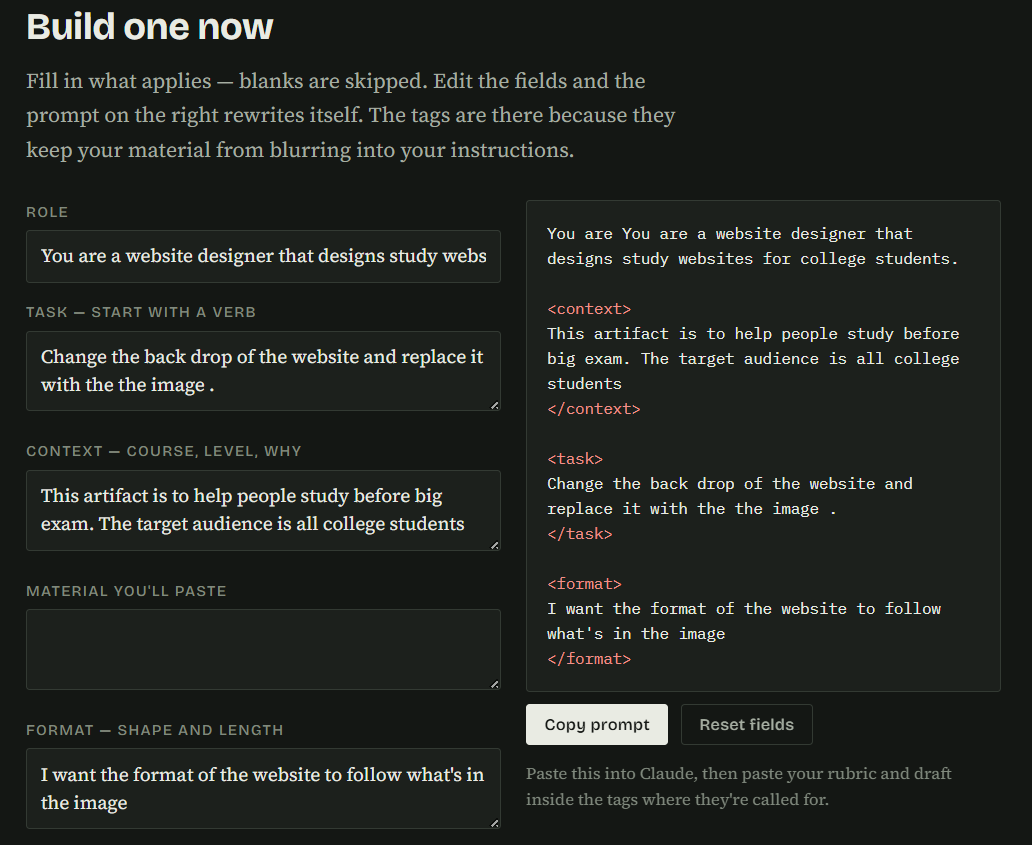
Prompt to create website: You are a website designer that designs websites for teachers and students. Your job is to create an AI tool that acts as a tutor instead of spitting out answers.

<context>
This AI tool should be similar to (CS050) that is a generative AI used for an intro course at Harvard University
</context>

<task>
Generate an AI tool that acts as a tutor to anyone and helps them guide them to get the answer, and furthermore informs them of the importance of effectively prompting to utilize fewer resources to negate the harm to the environment)
</task>

<format>
I want this to be formatted as a website that has (colors that are visually appealing to said audience.
</format

I create this prompt through my prompting kit, which is the Build one now agent that helps you create prompt to produce the best outputs. Using what we learn from the readings on prompting.

Cituation: Ad Hoc Committee on AI Use in Teaching, Learning, and Research Training. Report of MIT’s Ad Hoc Committee on AI Use in Teaching, Learning, and Research Training. Massachusetts Institute of Technology, 13 Aug. 2026, aiandeducation.mit.edu/report/.

Anthropic. “Prompting Best Practices.” Claude Platform Docs, platform.claude.com/docs/en/build-with-claude/prompt-engineering/claude-prompting-best-practices. Accessed 20 Sept. 2026.

Declaration of AI usage:I acknowledge the use of Generative AI tools in creating these artifacts: I used Claude to write the code for both tools from my own design specifications, and both artifacts call Claude at runtime to generate the tutoring dialogue.

LLM Unit Report – Week 5 Brady Rahz

Process

What is the prevalence of AI in the modern workforce and how should colleges be preparing their students for a system that values its usability? It is my personal belief that AI and the knowledge required to use and understand AI tools should be included in college curriculums in order to better ready its students for the real world. Having used LLMs in my own personal life as well as the content we’ve studied in our class, I have come to the conclusion that learning about AI and the best ways to utilize it is essential for students our age seeking employment in a world that increasingly supports AI knowledge. 

How i want to use

In terms of how I intend to use AI in the academic space, LLMs can and have been extremely helpful in terms of locating sources I would’ve never otherwise thought to have used and translating works that I wouldn’t have had access to beforehand. While the wider use of AI seems to be encouraged across the modern workforce, and I think that at least being able to navigate AI tools, proper prompting and the capabilities of both open and closed LLMs is an important skill to either emphasize or at least keep in reserve when searching for a job, in my own personal experience I have found the most success with having AI models and LLMs process large amounts of raw data as opposed to searching through it myself. Going forward, I plan to continue using LLMs in order to search for sources that are more obscure to me, “Zero-shot prompting involves providing the model with a direct instruction or question without any additional context or examples”, according to Google which would imply most of my success will come from useful information that can be gleaned from much more broad requests, especially considering most of my sources originate in non-english languages and therefore are primarily included on non-english speaking websites. In a similar fashion, I will also continue to use AI in order to translate said sources, as I’ve had more success using ChatGPT and Claude to translate certain PDFs and websites as opposed to Google Translate and my own translational abilities.

how i won’t use

 As for a way I will not be utilizing AI for my particular needs, it will most likely be in regards to studying specific material for either quizzes or classes. Quoting the UT Ai Prompting Literacy Report, “As you write your prompts, you’ll need an understanding of the topic or domain you’re directing the GenAI toward. As you write your prompts, you’ll need an understanding of the topic or domain you’re directing the GenAI toward.” With the exception of closed LLMs, the tendency for AI to misreport information on specific requests leaves making study guides far too at risk for having misinformation to have them be worth it, whereas more general outlines that will already be reviewed by a human are much safer, as well as closed LLMs, which will only pull from pre-approved sources and thus have a much lower chance to give me bad information.

relic

For my relic I have asked an LLM, specifically Google Gemini, if it is trustworthy as well as its response. It doesn’t outwardly appear to be hiding anything. It did only link its own setup as a response though.

going forward

Going forward, I will be paying more attention to which situations I use AI in and how I prompt effectively. With certain requests, LLMs won’t be as effective, such as needing specific information for studying materials. For other, more general requests however, LLMs seem to be a much more usable tool to get what I want.

sources

Credits: University of Texas System. (2025, November). Prompt literacy. UT Aspire. Google Cloud. “Prompt Engineering: Overview and Guide.” Google Cloud, 4 May 2026, https://cloud.google.com/discover/what-is-prompt-engineering. 

Image is a screenshot of a Google Gemini Prompt generated by me

AI For Augmentation, Not Automation: A look into AI use by Students

AI is has been integrated into every part of our digital lives from Google Searches to PDF summarizing. It takes us away from the past academic procedures to the new automated and sometimes augmented academic processes.That carries a lot of concerns surrounding trust, cognitive ability, ethics and hard work. The question now becomes, should college students use AI to complete their academic tasks? At first I was going to say no, but then I wanted to break down the question and highlight the keyword, complete. Focusing on that word, I now say yes.

I think AI is increasing cognitive debt, reducing the confidence of students and making so many students lazy. Alongside this, there are other negative effects of AI on students. I stand with that, but looking at the question again, I do want to refer to this quote from the article: “Beyond its implications for specific subjects and disciplines, the advent of AI demands a broader, holistic reassessment of the nature, scope and purpose of higher education today” and say that the purpose of AI in higher education should go towards the direction of grammar checking, proofreading and asking questions (Report – AI and Education, 2026). Students should use AI to complete their academic tasks, where complete involves grammar checking, follow up questioning to stimulate brain function and asking for clarity on instructions.These are things that save time, allow students to feel calm when they do engage in last minute work and feel at ease when they suddenly have a question about the assignment at 2am and cannot email a professor just to “make sure” they understand the assignment prompt.

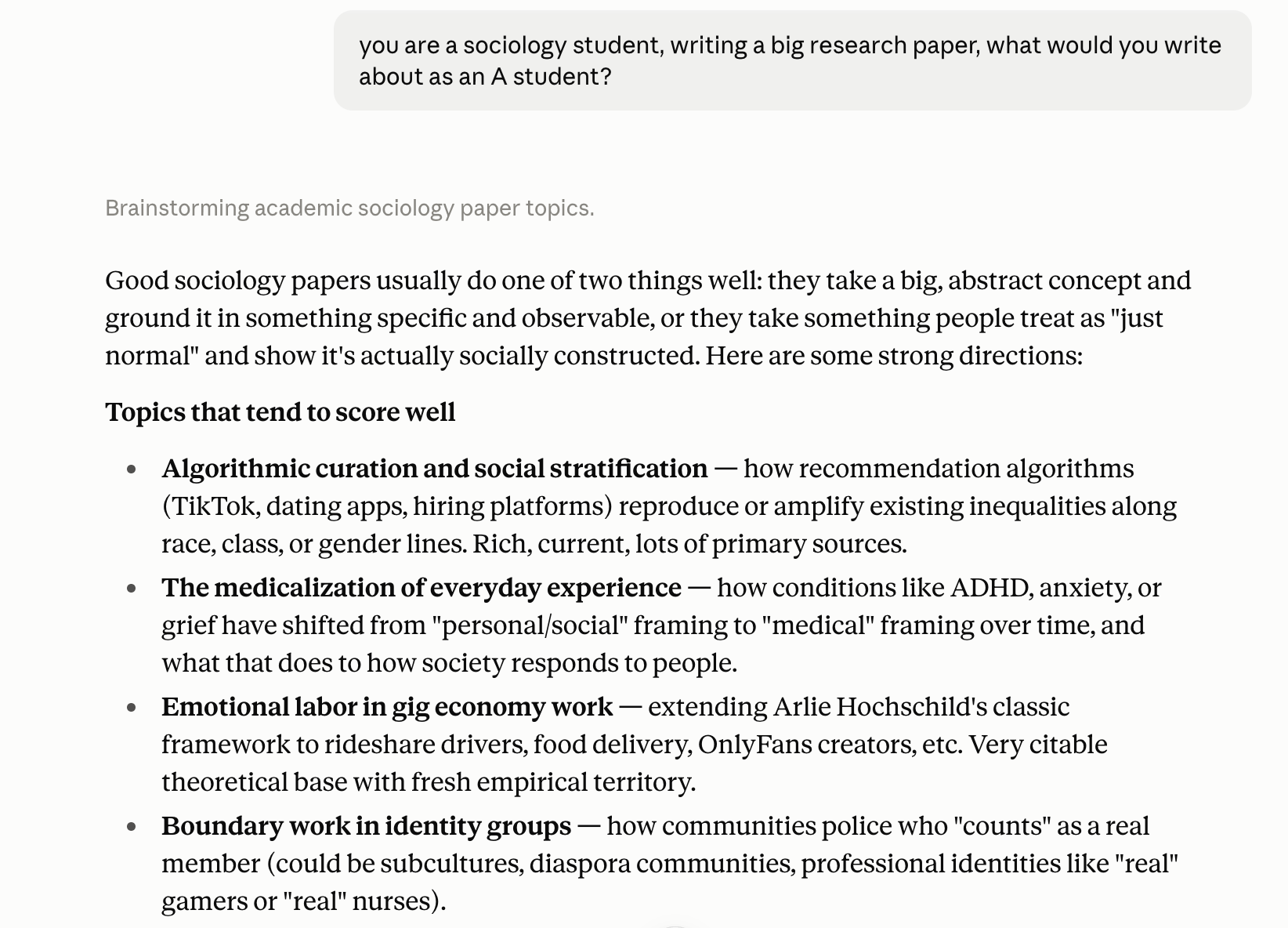
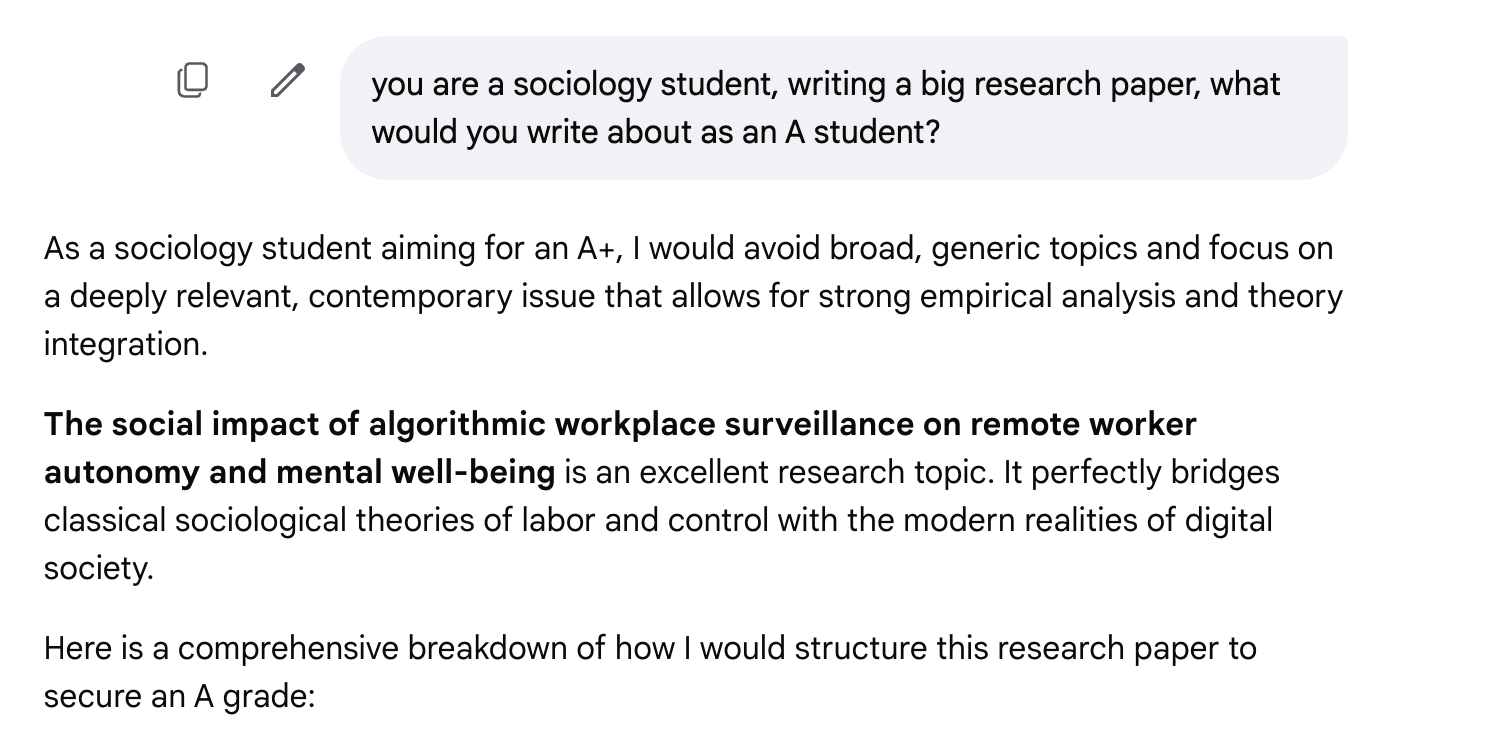
To simply show why AI is such a complicated tool, I tested out Google Gemini to see what it does best and does not do best. AI can surely be a helpful tool especially when a student has exhausted all other options or is running out of time. AI should definitely not replace initial thinking and writing but I think it can surely complete academic work as long as the prompts are drafted correctly and the student knows what to use it for and what to not use it for. I decided to ask Google Gemini to give me ideas for a research paper to write as a “Sociology student”.Then, I run the same prompt in Claude AI. In another instance, I asked Gemini to explain the snake and newts arms race to a student who knows nothing about biology. After running the Sociology prompt in both AI’s, I noticed a couple of differences. With Gemini, it gave just one topic with a breakdown of the paper format, while Claude gave a list of topics that tend to do well (without referencing where it knows that from). I then asked the two AI’s to explain the arms race for biology and they both did a good job at breaking it down. I tend to se and will use AI to explain concepts but contrary to popular belief, I would not use it to draft topics as a at first step. I would rather ask people, or sit and think about something and then I would run the same prompts through different AI’s.

I have realized that both AI’s read requests very differently. I was expecting both to give me a couple topics but I noticed that Google Gemini takes an objective approach than Claude and that could be for a couple reasons. To me, it seems like Claude is used to learning from a user’s language, tone and nuances but Gemini comes off as objective at every chance (even follow up prompts). I think what is most important is experimenting and knowing which AI to use for what. “In short, AI should be used to augment and enhance curiosity, creativity, and learning, not automate them” (Report – AI and Education, 2026).

What I know is that it is best to experiment, know what you want to use it for, and decide what you value most (cognitive ability, ownership, fulfillment). We once went on without Gen AI and we were quite alright so I feel that if we have to move with technology, then we should establish what we value most when using the AI. As a student, I think about how much ownership I want, and the confidence and originality. After students consider that, then I would say that college students should use AI (from AI writing assistants to advanced Gen. AI’s) to complete academic work if completing involves grammar checking, asking for clarification, using it without loss of confidence, and getting explanations with the ability to check the AI for facts and hallucinations. Lastly, we need knowledge on biases, ethics and fairness so that we as students can identify them. I would check for hallucinations, company statements on bias and asking AI follow up questions.

Citations APA

Report – AI and education. (2026). Mit.Edu. https://aiandeducation.mit.edu/report/


Module 2: LLMs

It is my belief that AI in its current form has no place in a current academic environment.

For my Senior Independent Study, I am reading the entirety of the published Garfield comic, and I thought it prescient to ask ChatGPT about some of the more minute details of the comic, as a way to test its accuracy. I assumed that, given how thoroughly Garfield has been documented, both in comic form and in discussion branching from the comic, there would be sufficient data for the LLM to make its estimations off of. When I asked “What are the names of Jon Arbuckle’s Neighbors?” GPT gave me a list: Lyman, Ms. Feeney, Mr. and Mrs. Wilson, and Randy. There are a few issues with this list, those being Lyman and the Wilsons. Lyman himself was Jon’s roommate for a time, before his character was slowly phased out. While this is an obvious hallucination, its mistake is still somewhat understandable. The Wilsons present a bigger issue. No such characters exist within the comic, nor, at least as far as I was able to find, within any other form of Garfield media. While a married couple does live next door to Jon, their names being Hubert and Reba, no last name has ever been provided. Curious, I requested the first names of the Wilsons, which ChatGPT responded with :

“I need to correct my previous answer: Mr. and Mrs. Wilson do not appear to have established first names in the Garfield comic strip. I can’t find reliable evidence that either character was given one.

So the answer is simply:

Mr. Wilson: first name unknown/not established

Mrs. Wilson: first name unknown/not established

My earlier mention of the Wilsons as Jon’s recurring neighbors was also likely mistaken. Thanks for prompting me to check it”

I further requested that the LLM “Provide the dates for the first appearances of Mr. and Mrs. Wilson within the Garfield comic strip,” to which ChatGPT refused to dignify my request with a response. Further testing revealed that, in fact, ChatGPT was now refusing to answer any questions.

In this sense, I argue that, while some use cases for an LLM are better than others, there is fundamentally no place for LLM usage in academia not related directly to the study of the function of LLMs. There are many dedicated tools such as Flourish that have a solid and valid place in academia, but those programs are not LLMs. Not only were my questions left unanswered, the question that I asked was one that could be answered easily with a simple Google search. I had wasted many more resources than I would have spent using regular internet searches.

Furthermore, inaccuracy is far from the biggest problem LLMs pose to the academic world. Within judicial circles, there is a doctrine known as the “Presumption of Regularity.” Under this presumption, United States courts automatically assume that any and all information presented by the United States government itself within a court of law is truthful. This serves to speed up certain processes, as well as make the federal government difficult to win a lawsuit against. However, in recent years, this “presumption of Regularity” has been faltering. recently, the Supreme Court has found that, due to a recent pattern of withheld truths and unwithheld falsehoods, the presumption of regularity can be paused in some circumstances. Within a similar timeframe, I have seen many professors grow weary of their students portraying the work of an LLM as their own. The “benefit of the doubt” as it were, is no longer routinely given. Conversely, I have spoken with many students who no longer trust their own professors, a few instances being students unsure if the equation they are being tasked with solving was generated with AI, and therefore, not truly solvable.

As this distrust grows and as LLMs become better and better at mimicking humanity, false accusations grow. In the article I’m Kenyan. I Don’t Write Like ChatGPT. ChatGPT Writes Like Me. Marcus Olang states that AI detection softwares “are not only unreliable but are significantly more likely to flag text written by non-native English speakers as AI-generated.” Much like any other large scale AI, these detectors are untrustworthy. There is, so far, no real solution to this problem, other than the wide-scale abandonment of LLM work offloading altogether.

Even if we disregard the erosion and potential destruction of trust in an academic, and potentially professional setting, it is a disservice to yourself to utilize and rely on such tools. As stated in the MIT preprint Your Brain on ChatGPT: Accumulation of Cognitive Debt when Using an AI Assistant for Essay Writing Task, “The LLM group’s participants performed worse than their counterparts in the Brain-only group at all levels.”

All AI generated portions of this blogpost have been designated above. No LLMs were used in any writing, planning, or brainstorming step of this blogpost. The built-in spellcheck was utilized.

The LLM Dilemma

The Dilemma: With the rise of publicly available Large Language Models the question of it’s use in academics has been one educators and students have pondering The past two weeks of class have made it quite clear that the use of LLMs in academia to “help” with cognitive tasks is a slippery slope. All of that said, I believe that students should not use ANY generative AI models to complete academic task.

The Reasoning/Process: There are two sources we looked at in class which, to me, represent the biggest issues for students or really anyone relying on LLMs to help with cognitive task or with generating images and data. Firstly, the MIT report, which looked at the cognitive effects of using LLMs when writing an essay compared to those who simply used their brain to write it. While in truth their study wasn’t perfect, it doesn’t address AI use in the medical or scientific field, the results for the academic field are hard to argue against. Within this study MIT took 54 participants and split them up into three groups. The LLM group, Search Engine group and Brain-only group. By the end of the study it was shown that more external help the participants had in writing the essay the less their brain connectivity was. “Brain connectivity systematically scaled down with the amount of external support: the Brain‑only group exhibited the strongest, widest‑ranging networks, Search Engine group showed intermediate engagement, and LLM assistance elicited the weakest overall coupling.” The Brain-only and Brain-to-LLM participants showed a greater sense or ownership, memory recall, and overall better scoring.

When we did our own little study in class, while factors like the size of class or the time we had to produce our arguments definitely impacted the results, they still overall showed the exact same thing. Those who wrote their arguments using their own brain had a better time recollecting what they had written in comparison to those who relied on a LLM to write out their entire argument for them.

Another aspect of this is the use of AI image generation and the bias it can present. AI image generation can be used on things like presentations for example, However AI’s bias producing issues are a major hit against it when using it in such a way. Since, generative AI models produce sentences and images by predicting the statistical likelihood of what comes next or what should be generated based on token patterns they may generalize already biased data, then present and even more biased version of it. What’s worse is then the models train itself on that output thus making the bias even worse.

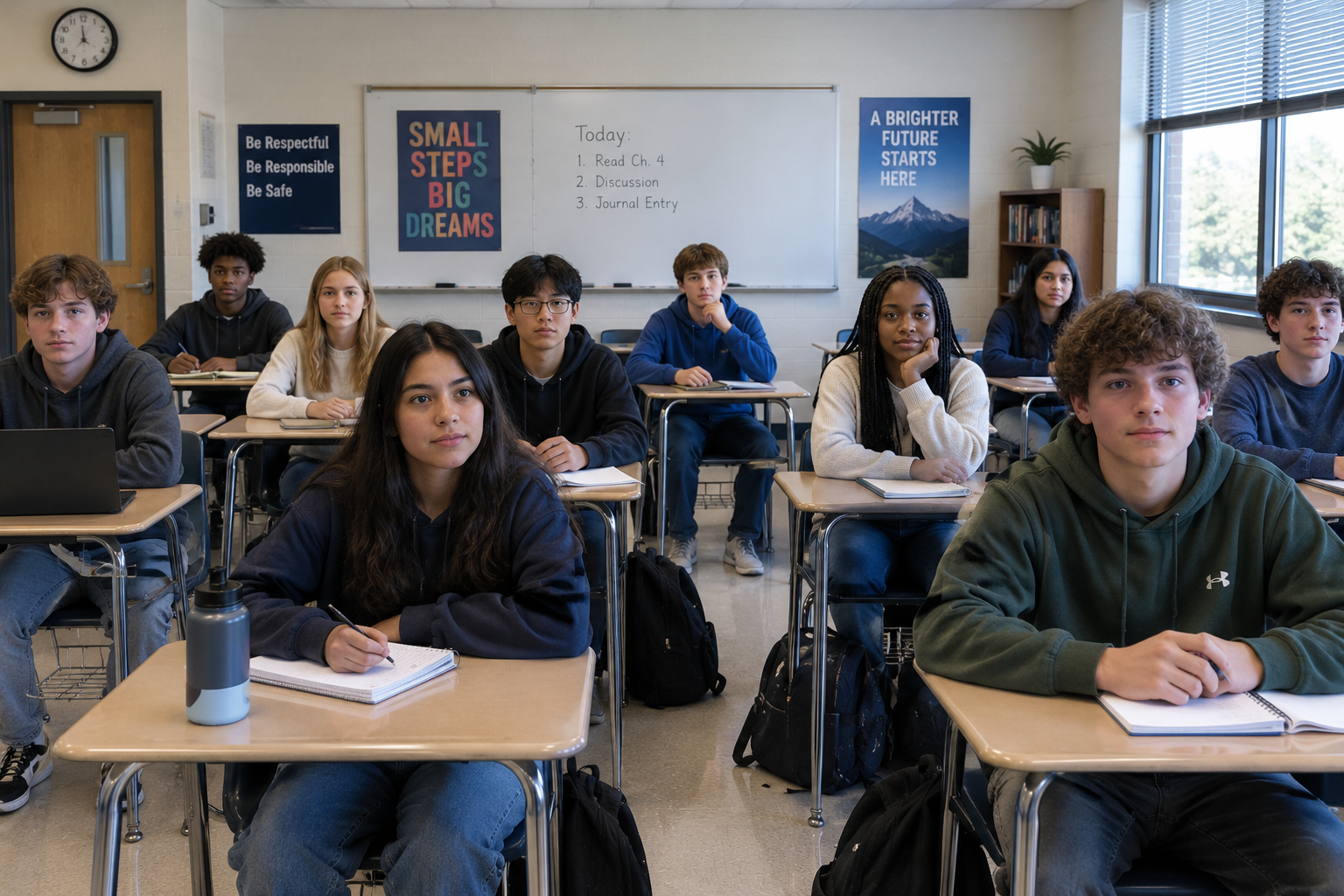
Artifacts – This can be demonstrated in the generated Image below. One of the main things I tested was diversity when it came to image generation. Thus I asked ChatGPT to create an image of the Average American classroom. To not possibly skew the results I left the subject out of the prompt. Here you can see a classroom of students. To untrained eye this looks like a pretty good representation of what the American classroom looks like nowadays, right? Well, not exactly. Firstly, while there is diversity here, it’s basic. The biggest issue is not only the vagueness of ethnic background ( is anyone here from Europe, South America, Mexico, Africa?) but also gender is pretty much as basic as it gets. There is no clear signs of anyone who may not identify as male or female or who may have perhaps transitioned. Now, granted asking the generative AI to put that there may make the system draw way too much attention to it rather than just inserting it casually and naturally. Lastly everyone is wearing the same hoodie and the same pear of jeans.

A portion of the main home page of the MIT report summarizes my thoughts of LLM use in academia. “As the educational impact of LLM use only begins to settle with the general population, in this preliminary study we demonstrate the pressing matter to explore further any potential changes in learning skills based on the results of our study. The use of LLM had a measurable impact on our participants, and while the benefits were initially apparent, as we demonstrated over the course of 4 sessions, which took place over 4 months, the LLM group’s participants performed worse than their counterparts in the Brain-only group at all levels: neural, linguistic, scoring.”

Cheung, J. (2023, August 21). How AI image generators make bias worse. London Interdisciplinary School. https://www.lis.ac.uk/stories/how-ai-image-generators-make-bias-worse

Kosmyna, Nataliya. “Your Brain on Chatgpt: Accumulation of Cognitive Debt When Using an AI Assistant for Essay Writing Task.” Your Brain on ChatGPT: Accumulation of Cognitive Debt when Using an AI Assistant for Essay Writing Task, June 2025. https://www.brainonllm.com/.

Module 2 project report: LLMs

Should College Students Use Generative AI for Academic Work?

Questioning and Framing

After reading the MIT Report on generative AI in higher education and thinking about my own experiences with AI, I believe college students should not use generative AI to complete the academic work they are expected to do themselves. AI can be useful, but there is an important difference between using a tool to support learning and using it to avoid the learning process altogether.

The MIT report reassures me of my opinion, but the author explains that the biggest concern is that “many uses of AI deprive students of the opportunity to learn” (MIT). This stood out to me because the purpose of college assignments is not to get the correct answer every time. Assignments are supposed to make students practice thinking, solving problems, and making decisions with their personal judgment.

My biggest problem with using AI for assignments is the lack of critical thinking skills. It is very easy to have AI chat bots complete your assignments without having to think about it. The MIT report stated that “getting the right answer from a chatbot can create the illusion of learning”(MIT). If AI immediately removes that struggle, students may finish the assignment without actually developing the skills the assignment was designed to teach.

Process

The approach we took really helped me understand the key differences between human and AI answers. Everyone in class was given the same prompt, but the twist was that some had to answer with AI and others answered with their judgment. The results showed that, in the limited time to answer, the critical thinkers elaborated with our groups and finished in the allotted time, while the AI users were still writing answers. We also found that people using their own knowledge were able to recall the answer and the question that was asked more promptly, just by writing it out.

This process helped me distinguish between using AI as an academic shortcut and using technology as a learning tool. If I ask AI to write an entire paper that I am supposed to write, then the AI has completed the central academic task for me.

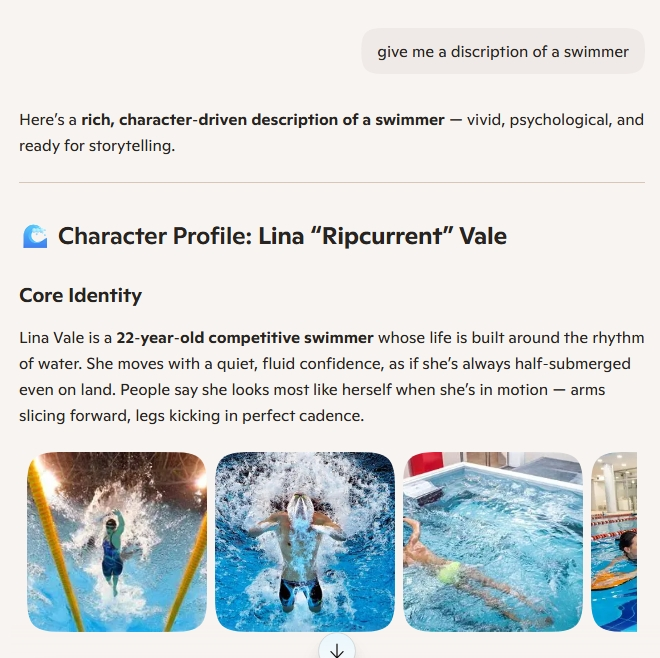
Another example we used was asking different AI sites, such as ChatGPT and Copilot, the same question. Interestingly enough, each site gave a different answer in its own way. The prompt my group asked was “Describe a runner and swimmer”. One site gave an AI drawing of a “runner”, while the other gave a daily life schedule of the athlete. This just shows you’ll never get the same response, so it’s important how reliable and credible your information is.

Artifacts

The photo that ChatGPT depicted a stereotypical white female runner. While one of my other classmates used Claud, it gave a actually cartoon running simulation where you can adjust the speeds. Other examples are the writing flow is different between the AI-generated answers and the human ones. The AI answers were more formal and used grammar that a student under a time limit wouldn’t use.

These artifacts are important because they show that the problem with AI in college is not simply that AI produces bad answers. The problem is that a good-looking answer can hide the fact that the student did not perform the thinking or practice that the assignment was intended to require. The images that these sites produced also show that every question won’t give the exact answer.

Reflections

The biggest thing I learned from this project is that the convenience of generative AI can actually make it harder to recognize what students are learning. If a student uses AI to complete an assignment, the finished product may look successful even though the student may not have developed the underlying skill.

When a task is difficult or time-consuming, there is an obvious temptation to let AI do more of it. AI is designed to make difficult tasks feel easier, and that can be useful. But in school, difficulty is not always a problem that needs to be eliminated. Sometimes difficulty is the point.

Conclusion

College is a place where our academic freedom can be shown through our authentic work. Generative AI can make academic tasks faster and easier, but faster and easier are not always the goals of education.

The MIT report itself recognizes both sides of the issue. It says AI has the potential to help students “be more productive, learn more efficiently, and build skills,” while also warning about the risks AI creates for learning, teaching, and the social environment of education.

For me, I learn better in situations where I make mistakes and eventually figure things out for myself. Therefore, I believe college students should not use generative AI to complete academic tasks that are meant to measure or develop their own knowledge and skills.

Work Cited

Nataliya Kosmyna et al, MIT Media Lab (2025). Your Brain on ChatGPT: Cognitive Debt when Using an AI Assistant for Essay Writing Task

Image 1: AI Generated from ChatGPT

Image 2: Screenshot from chat with Copilot