Data to a spreadsheet

Pierce Duong DH analusos

01
Interesting Questions

1. Are there repeated stories in different issues? How are they presented?

2. I am mainly interested in how contexts change across time. By analyzing these stories across time, scholars might be able to identify the values most important for each year. It may also be interesting to discern if any stories, and subsequent voices are being ignored.

02
Spreadsheet Organization


Rows would represent each data instance. Each row here would represent an issue by The Voice. Characteristics within columns could look like type of story, year, editor characteristics, etc.

03
Data Privacy, my approach

I do not expect any ethical data problems. Participants of The Voice, by nature, expect their work to be received publicly. My only concern might be for older issues, who were not expecting their storeis to be digitized and widely acceptable.

Title

Short Description

The Wooster Voice https://www.instagram.com/thewoostervoiceofficial/ © Copyright 2026 The Wooster Voice.

A few good questions were posed by my group. They mainly consisted of questions related to the composition of The Voice itself, such as the length of articles in the Sports section and how they relate to the performance of the team, and the changing ratios between local and national news stories published in the paper itself.

If we were to focus on the question of changing story scope in publication, a few keywords would need to be created. We would need to define what ‘scope’ really is in this case, but at a glance, we could divide all stories into 5 categories, those being non-campus articles, non-campus articles with mentions of impact on campus community, non-campus article with viewpoints from campus residents, campus article with mentions of non-campus events, campus article with little to no mention of non-campus events. These definitions are muddy and awful, but refinement would likely emerge as a result of actual work put in.

I have no concerns about data privacy in this dataset, as all information is publicly available, and has been published by people expecting the information they publish to be seen and analyzed by the public

The Wooster Voice https://www.instagram.com/thewoostervoiceofficial/ © Copyright 2026 The Wooster Voice.

Data blog post

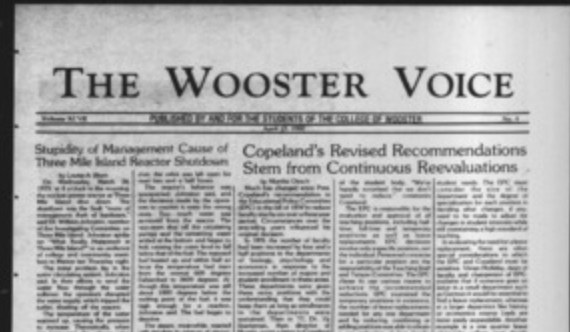
A picture of a Wooster Voice edition
The Wooster Voice. (2026). The voice: 1971-1980 | “The voice” student newspaper collection | the college of Wooster. Wooster.Edu. https://openworks.wooster.edu/voice1971-1980/

After looking at the digitized Wooster Voice archives I would be interested in exploring how exclusive the newspaper was to the college community back when it was the print version only. I would also want to look at the kinds of topics it covered and content distribution (eg. whether political news was more than campus gossip). I was curious about who the Voice’s target audience is today versus who it was written for and how that affects exposure to the campus community. These questions are important because they reveal how students have made sense of their experiences on campus and how student culture has evolved. Largely, in DH, they give a range of possible data points that can be researched.

For my questions, I would organize my spreadsheet so that each row represents a single article from the Voice archives. For example, with the content distribution question, each column would have publication date, title, author, topic category (politics, entertainment, arts, sports, greek life etc). I could also do how many student features, their class year, major, and the kind of topics portrayed. For the vocabulary, i would use short words, category kid of labels like politics, alpha, gamma, greek, basketball, administration, student life etc. Anything that makes SEO efficient and also just to have each article coded with specific words/terms.

Data privacy is a significant concern in this project because exposure has changed from print to digital and that comes with ethical concerns especially regarding student features from the past. They may not have anticipated their college time to be digitized years later and very accessible. My spreadsheet would include identifiable information like names and quotes so i would probably ask whether it is necessary to record very personable information or using pseudonyms for certain topics where someone may have said something very personal and exclusive to campus community like the gossip section (that maybe they don’t want someone outside to know).


Post #2: Voice Blog

Wooster Hazing frequency

My study of the Wooster Voice would track how often articles featuring or about hazing have appeared in the paper

The questions that we discussed as a group mostly pertained to what types of articles appeared in the Voice throughout the years and how often the paper had been engaged in plagiarism, though since I couldn’t find that article I’ve settled for the next best thing; hazing. It’s a topic I’ve noticed a few times throughout my viewing of the Voice and would assume it’s one that has become more frequent throughout the years. I think it’d be interesting to see the students perspective on something that’s recognized as a pretty frequent issue across the country.

My dataset and spreadsheet would most likely search the Voice’s archives for articles containing the words “haze”, “hazing” or any other related terms and sort by inclusion in the title and body, frequency of how often the word is used throughout the article, and the time that issue came out. I imagine this would be a pretty basic way to track not just how often students fin it interesting to write about but increasing with the College’s attempts to stop it. It would also be interesting to compare this to other college newspapers and general media coverage of hazing, which I feel has been ever increasing in recent years.

For privacy, names wouldn’t need to be included, authors or those included in the articles otherwise, though anyone with access to the Voice’s archives could theoretically look up the articles for themselves to find the potential increase in reports.

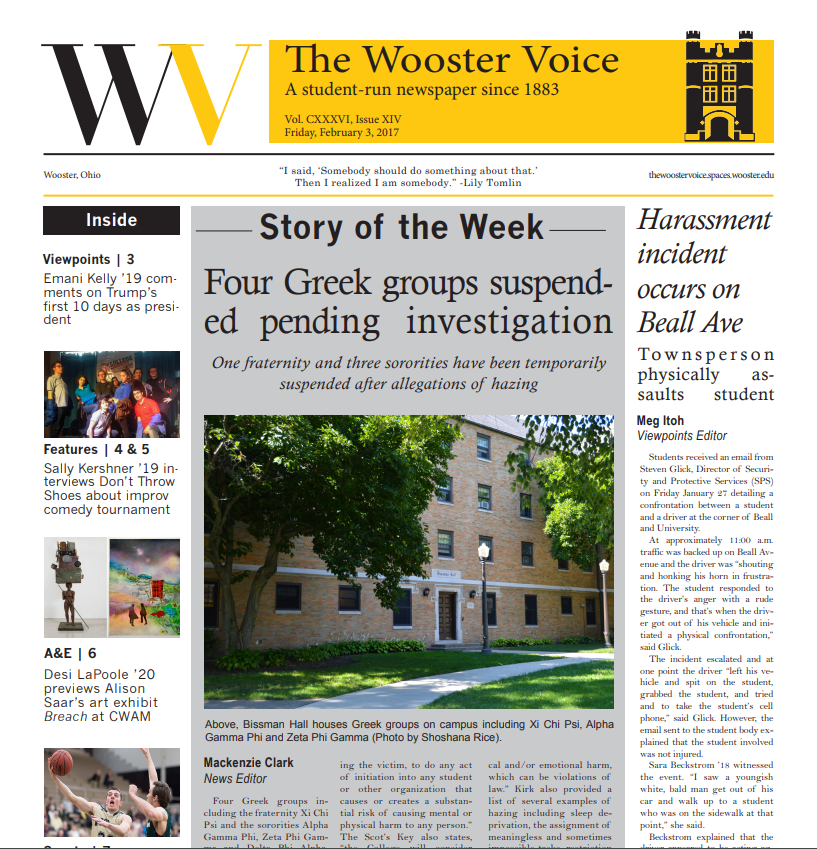
Image Credit: “Wooster Voice Front Page” 2/3/17 https://openworks.wooster.edu/cgi/viewcontent.cgi?article=1014&context=voice2012-2020

Post #2

Based on what my group talked about in class I think that we can ask questions like how do the topics that are talked about change over time. If you look at what they were talking about over the years you can see that at the time things like sports, actual student life and complaints, and politics or big events in the country were showing up way more than anything else. It’s interesting because it shows what was more important at different points in Wooster’s past because you see a difference in what students talk about today compared to what they talked about back then.

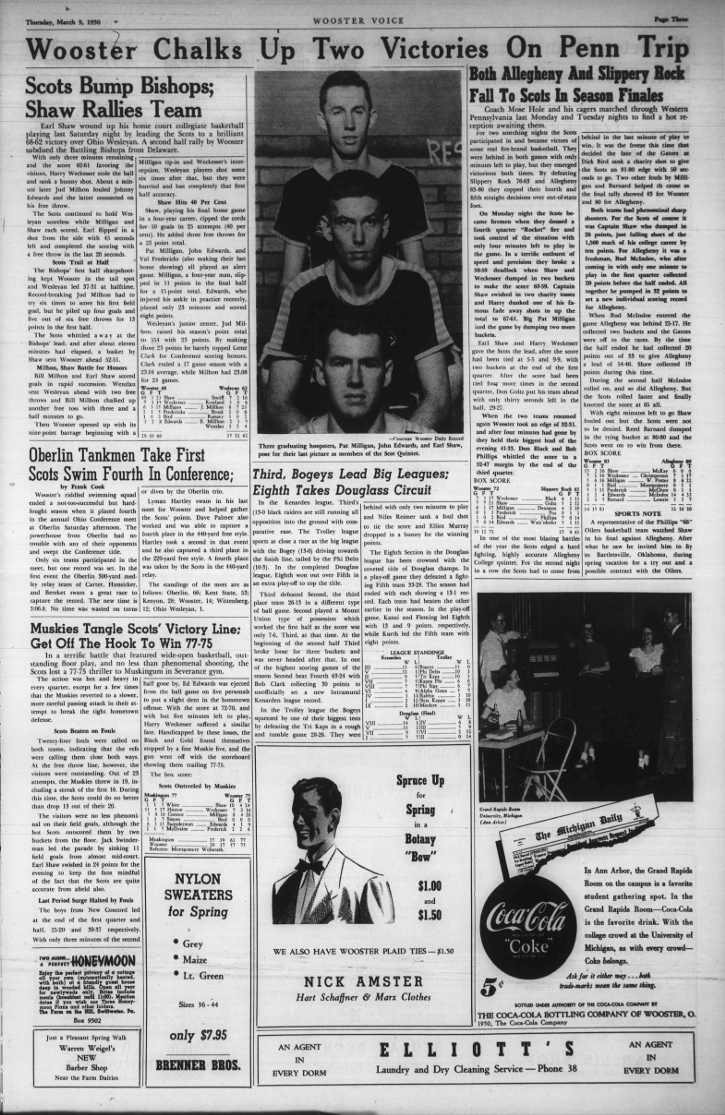
Front page of The Wooster Voice newspaper from March 9, 1950

The Wooster Voice (1950) [Newspaper page]. 9 March 1950. The College of Wooster Open Works. https://openworks.wooster.edu/voice1941-1950/211. Rights information: The College of Wooster Open Works.

If I was to make a spreadsheet for this, I would make every row represent an article. The columns would be things like the date, the title of the article, the topic or the type of article, and the people or the groups that are being talked about. The hardest thing would be picking what info is actually worth putting on the spreadsheet. 

For privacy I think I would just make sure I am careful about what I use and how I’m using it, I wouldn’t really use anything I don’t have permission for unless it’s just open to the public. I will base how deep I go into using whatever info I am using based on how personal the information is.