
AI For Augmentation, Not Automation: A look into AI use by Students

AI is has been integrated into every part of our digital lives from Google Searches to PDF summarizing. It takes us away from the past academic procedures to the new automated and sometimes augmented academic processes.That carries a lot of concerns surrounding trust, cognitive ability, ethics and hard work. The question now becomes, should college students use AI to complete their academic tasks? At first I was going to say no, but then I wanted to break down the question and highlight the keyword, complete. Focusing on that word, I now say yes.

I think AI is increasing cognitive debt, reducing the confidence of students and making so many students lazy. Alongside this, there are other negative effects of AI on students. I stand with that, but looking at the question again, I do want to refer to this quote from the article: “Beyond its implications for specific subjects and disciplines, the advent of AI demands a broader, holistic reassessment of the nature, scope and purpose of higher education today” and say that the purpose of AI in higher education should go towards the direction of grammar checking, proofreading and asking questions (Report – AI and Education, 2026). Students should use AI to complete their academic tasks, where complete involves grammar checking, follow up questioning to stimulate brain function and asking for clarity on instructions.These are things that save time, allow students to feel calm when they do engage in last minute work and feel at ease when they suddenly have a question about the assignment at 2am and cannot email a professor just to “make sure” they understand the assignment prompt.

To simply show why AI is such a complicated tool, I tested out Google Gemini to see what it does best and does not do best. AI can surely be a helpful tool especially when a student has exhausted all other options or is running out of time. AI should definitely not replace initial thinking and writing but I think it can surely complete academic work as long as the prompts are drafted correctly and the student knows what to use it for and what to not use it for. I decided to ask Google Gemini to give me ideas for a research paper to write as a “Sociology student”.Then, I run the same prompt in Claude AI. In another instance, I asked Gemini to explain the snake and newts arms race to a student who knows nothing about biology. After running the Sociology prompt in both AI’s, I noticed a couple of differences. With Gemini, it gave just one topic with a breakdown of the paper format, while Claude gave a list of topics that tend to do well (without referencing where it knows that from). I then asked the two AI’s to explain the arms race for biology and they both did a good job at breaking it down. I tend to se and will use AI to explain concepts but contrary to popular belief, I would not use it to draft topics as a at first step. I would rather ask people, or sit and think about something and then I would run the same prompts through different AI’s.
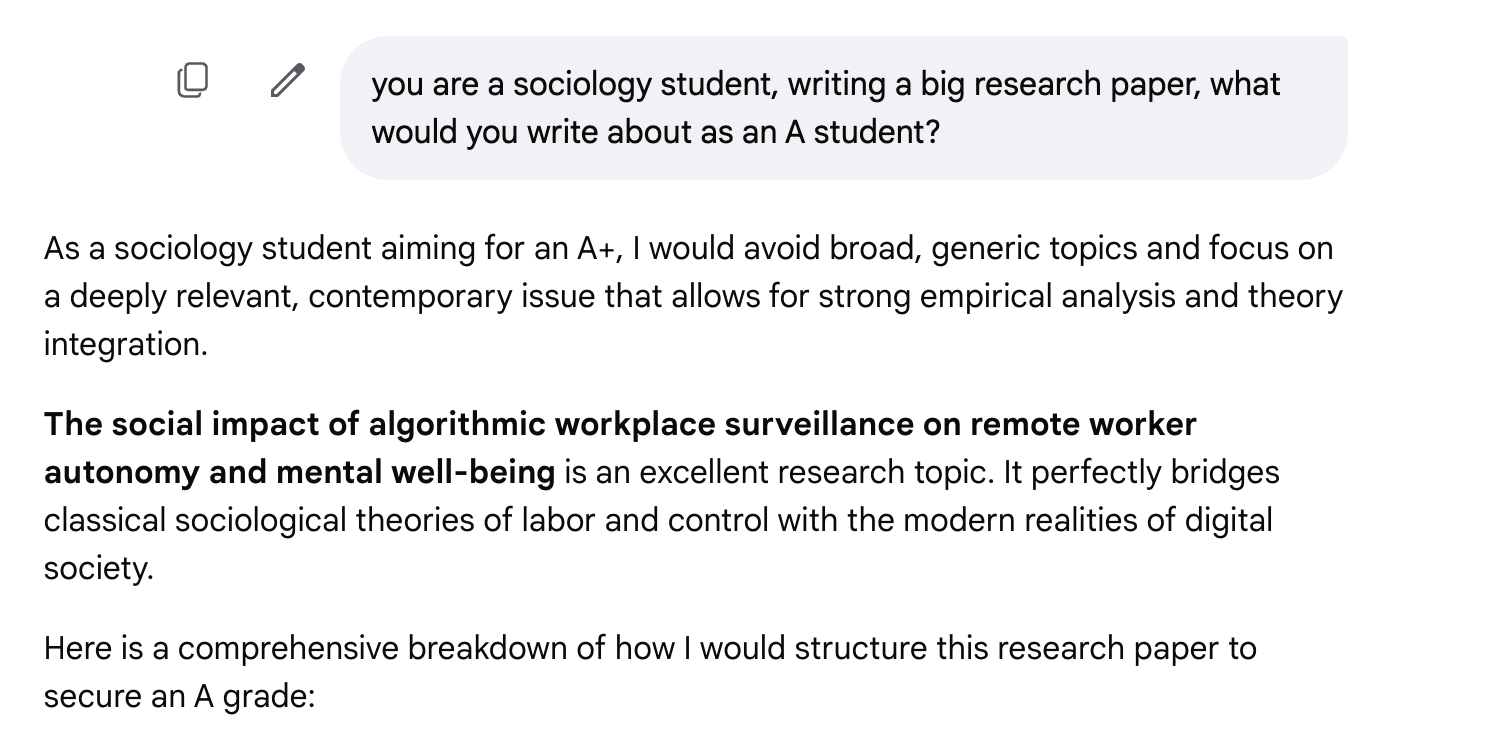
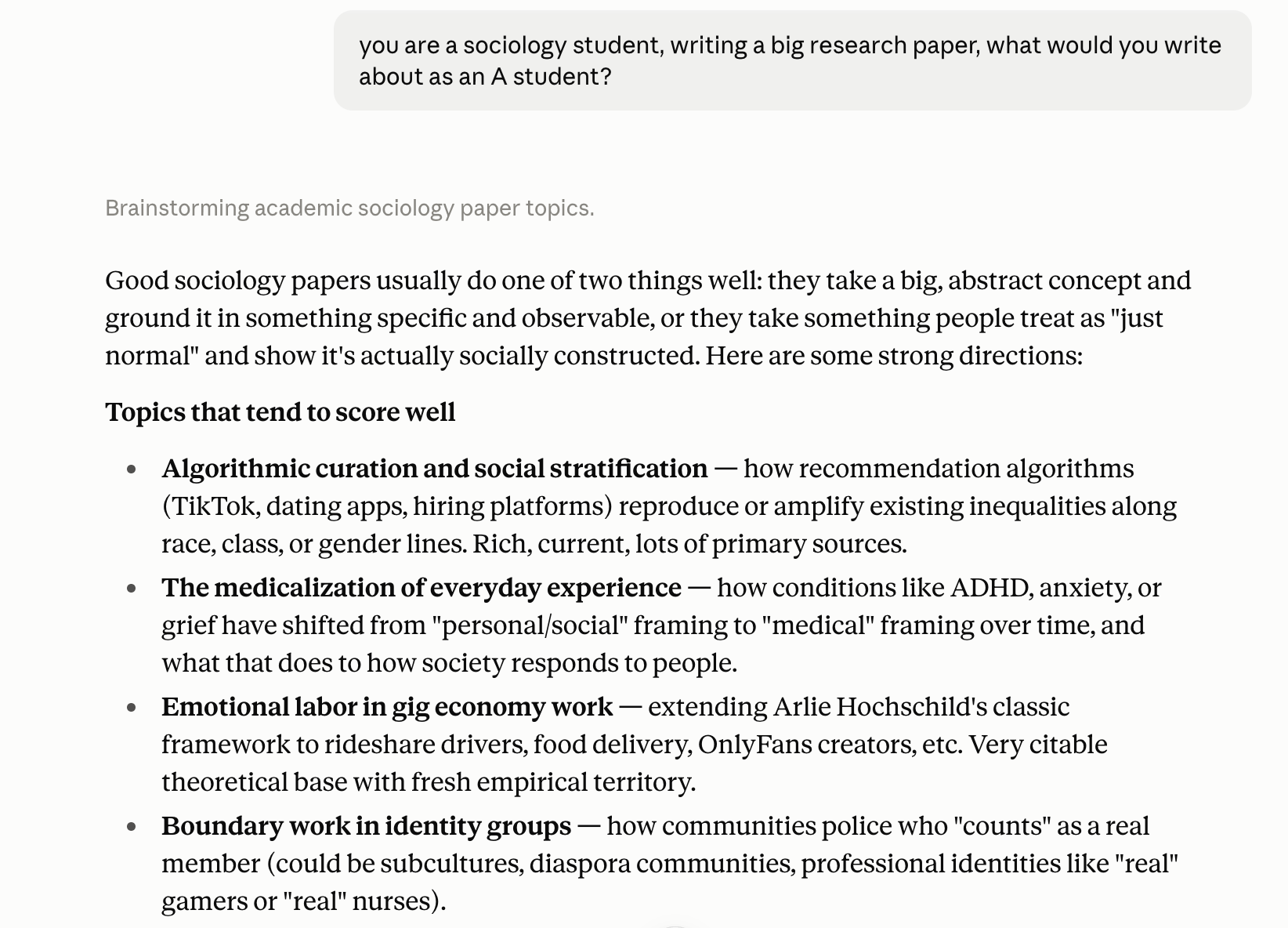
I have realized that both AI’s read requests very differently. I was expecting both to give me a couple topics but I noticed that Google Gemini takes an objective approach than Claude and that could be for a couple reasons. To me, it seems like Claude is used to learning from a user’s language, tone and nuances but Gemini comes off as objective at every chance (even follow up prompts). I think what is most important is experimenting and knowing which AI to use for what. “In short, AI should be used to augment and enhance curiosity, creativity, and learning, not automate them” (Report – AI and Education, 2026).

What I know is that it is best to experiment, know what you want to use it for, and decide what you value most (cognitive ability, ownership, fulfillment). We once went on without Gen AI and we were quite alright so I feel that if we have to move with technology, then we should establish what we value most when using the AI. As a student, I think about how much ownership I want, and the confidence and originality. After students consider that, then I would say that college students should use AI (from AI writing assistants to advanced Gen. AI’s) to complete academic work if completing involves grammar checking, asking for clarification, using it without loss of confidence, and getting explanations with the ability to check the AI for facts and hallucinations. Lastly, we need knowledge on biases, ethics and fairness so that we as students can identify them. I would check for hallucinations, company statements on bias and asking AI follow up questions.

Citations APA

Report – AI and education. (2026). Mit.Edu. https://aiandeducation.mit.edu/report/


Think about the Little Guy… That means YOU!

Point of Contention: Should college students use generative AI to complete their academic tasks?

Main takeaway: Training people to navigate LLMs and identify generated bodies of work remains important; however, establishing an academic foundation must take priority.

I do not believe that students should use generative AI when completing assignments. When approaching AI, students must consider the consumer-producer relationship. LLMs are trained on human data, and as LLM users, our continued usage only trains them further. While LLM users may find great use in this tool’s ability to produce quick results, even at a systemic level, we must remain cognizant of the true winners: AI developers and companies.

The other half of this relationship- you, us, the consumers, can easily measure the detriments done unto us. Consider this quote from Jon Cheung describing the dangers of how AI exacerbates biases:

“For A.I. image generators trained on biased datasets. They will fill the Internet with biased images, which will then be fed back into datasets for other A.I. image generators, that will then create even more biased images and so on and so forth, thus creating a vicious feedback loop which will both spread and intensify existing biases” (2023).
Scholars are expected to possess critical-thinking skills that transcend bias. Therefore, learning students should not expect A.I. image generators to teach us anything except about A.I. image generators.

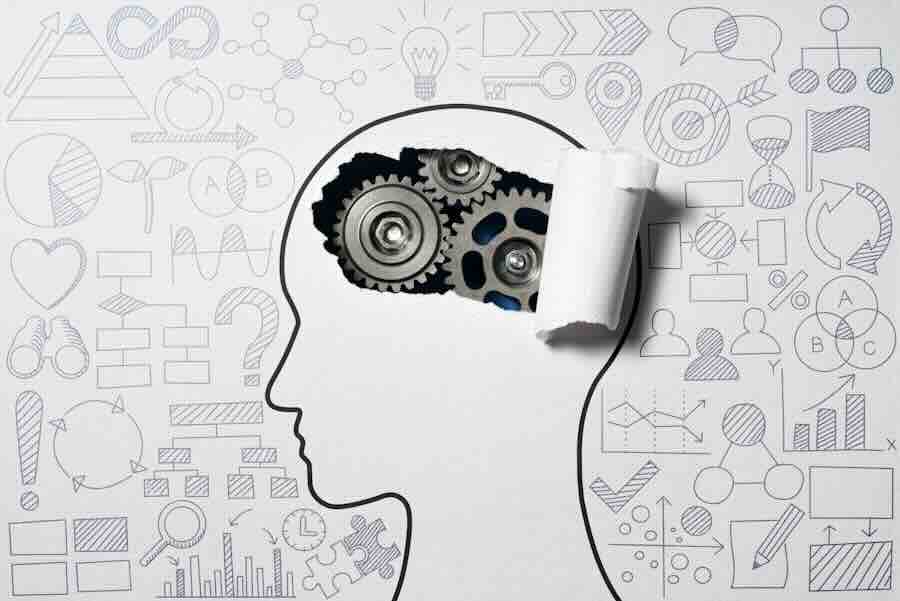
The strongest weapon against ignorance has always been curiosity and knowledge. AI actively degrades our cognitive ability- our ability to think critically. The MIT study we discussed in class demonstrates this degradation clearly, describing essays as soulless and lacking originality (2025, p.72). Otherwise known as cognitive debt, which “defers mental effort in the short term but results in long-term costs, such as diminished critical inquiry, increased vulnerability to manipulation, decreased creativity” (2025, p. 151). In other words, AI feeds us biased visual information while concurrently degrading our skills to properly navigate its output.

Taken from Getty Images. Keep your gears smooth and running.

These various practices in class have led me to be extremely cautious about how many “menial tasks” I delegate to LLMs. I hope to remain cognizant of how much I truly value my mind, and I hope that everyone reading this feels similarly. To me, these fears are inherently linked to illnesses like dementia or Alzheimer’s. The only exception is that we as consumers, are actively inflicting this illness upon ourselves, individually and as a society.

That being said, I do find it important for consumers to know their product, especially as it infiltrates its way into seemingly every crevice of society and life. As scholars and as informed users, we must understand its strengths to know its weaknesses, and vice versa. And as AI continues to grow, it will almost become inevitable to avoid it- for instance, Copilot and Google’s AI-generated overviews. I urge everyone to be diligent of their regular practices, especially ones that seem free…

Citations:

Cheung, Jon. “How AI Image Generators Make Bias Worse.” LIS, 21 Aug. 2023, https://www.lis.ac.uk/stories/how-ai-image-generators-make-bias-worse.

Kosmyna, N., Hauptmann, E., Yuan, Y. T., Situ, J., Liao, X.-H., Beresnitzky, A. V., Braunstein, I., & Maes, P. (2025). Your Brain on ChatGPT: Accumulation of Cognitive Debt when Using an AI Assistant for Essay Writing Task [Preprint under review][1][2]. MIT Media Lab[1]. https://www.brainonllm.com/

LLM

A meme about AI taking over.

I think some people feel like AI is this big black hole of countless data and there have been theories of AI taking over and someday attacking us/ ruling over us. Thats all very interesting but I think its best to learn about what to put into AI and what not to put into it as well as how to manipulate it.

I would say that I never thought about the fact that GenAI has a limited amount of resources to work with. I always thought it had an unbelievably vast amount of data to access.

I am learning a lot more about hallucinations which are “incorrect information generated from patterns that do not really exist”(The University of Texas System, 2025, p. 3). It has definitely happened many times before but I am now realizing that what I do in response to that, is asking the AI if it telling the truth and that if it truly does not know, it should let me know (it works!). For my academics, whenever I have to use AI, I try to run the same info through at least two AI’s and then take bits of information to a Google search.

I think the concept of closed and open LLM sort of addresses many privacy worries of using AI. A lot of people become unknowingly dependent on AI and end up putting their private information into chats. I think closed LLM could ease such worries in the sense that it is confined to certain people in an organization and as long as we minimize the access to our privacy, then it is possible to let go of such worries.

CITATION: The University of Texas System. (2025, November 11). UT aspire prompt literacy. The University of Texas System. https://utsystem.edu/documents/docs/general-documents/2025/ut-aspire-prompt-literacy

IMAGE: boat-dog. (2025). Reddit. Reddit.Com. https://www.reddit.com/media?url=https%3A%2F%2Fpreview.redd.it%2Fi-asked-chatgpt-to-make-a-meme-showing-how-youd-treat-me-if-v0-6jzvle5mbfue1.jpeg%3Fwidth%3D1024%26format%3Dpjpg%26auto%3Dwebp%26s%3D0eb800608e9e851a4e08dc14e279376ff858e1ee