
Think about the Little Guy… That means YOU!

Point of Contention: Should college students use generative AI to complete their academic tasks?

Main takeaway: Training people to navigate LLMs and identify generated bodies of work remains important; however, establishing an academic foundation must take priority.

I do not believe that students should use generative AI when completing assignments. When approaching AI, students must consider the consumer-producer relationship. LLMs are trained on human data, and as LLM users, our continued usage only trains them further. While LLM users may find great use in this tool’s ability to produce quick results, even at a systemic level, we must remain cognizant of the true winners: AI developers and companies.

The other half of this relationship- you, us, the consumers, can easily measure the detriments done unto us. Consider this quote from Jon Cheung describing the dangers of how AI exacerbates biases:

“For A.I. image generators trained on biased datasets. They will fill the Internet with biased images, which will then be fed back into datasets for other A.I. image generators, that will then create even more biased images and so on and so forth, thus creating a vicious feedback loop which will both spread and intensify existing biases” (2023).
Scholars are expected to possess critical-thinking skills that transcend bias. Therefore, learning students should not expect A.I. image generators to teach us anything except about A.I. image generators.

The strongest weapon against ignorance has always been curiosity and knowledge. AI actively degrades our cognitive ability- our ability to think critically. The MIT study we discussed in class demonstrates this degradation clearly, describing essays as soulless and lacking originality (2025, p.72). Otherwise known as cognitive debt, which “defers mental effort in the short term but results in long-term costs, such as diminished critical inquiry, increased vulnerability to manipulation, decreased creativity” (2025, p. 151). In other words, AI feeds us biased visual information while concurrently degrading our skills to properly navigate its output.
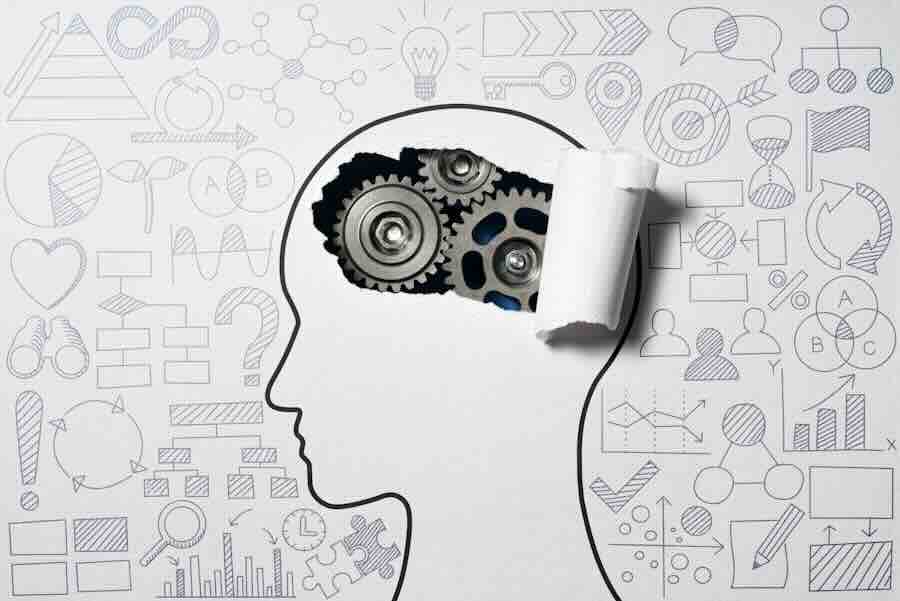
Taken from Getty Images. Keep your gears smooth and running.

These various practices in class have led me to be extremely cautious about how many “menial tasks” I delegate to LLMs. I hope to remain cognizant of how much I truly value my mind, and I hope that everyone reading this feels similarly. To me, these fears are inherently linked to illnesses like dementia or Alzheimer’s. The only exception is that we as consumers, are actively inflicting this illness upon ourselves, individually and as a society.

That being said, I do find it important for consumers to know their product, especially as it infiltrates its way into seemingly every crevice of society and life. As scholars and as informed users, we must understand its strengths to know its weaknesses, and vice versa. And as AI continues to grow, it will almost become inevitable to avoid it- for instance, Copilot and Google’s AI-generated overviews. I urge everyone to be diligent of their regular practices, especially ones that seem free…

Citations:

Cheung, Jon. “How AI Image Generators Make Bias Worse.” LIS, 21 Aug. 2023, https://www.lis.ac.uk/stories/how-ai-image-generators-make-bias-worse.

Kosmyna, N., Hauptmann, E., Yuan, Y. T., Situ, J., Liao, X.-H., Beresnitzky, A. V., Braunstein, I., & Maes, P. (2025). Your Brain on ChatGPT: Accumulation of Cognitive Debt when Using an AI Assistant for Essay Writing Task [Preprint under review][1][2]. MIT Media Lab[1]. https://www.brainonllm.com/
My Thoughts on AI – Project Report 2

AI Used: ChatGPT for prompts & Grammarly for spell-check

College students should not use AI for academic work because, in both the MIT study and our own, it was shown that people do not remember their work, don’t really learn, and it takes away the ability to think cognitively. A quote from the study that shows this is, “LLM-to-Brain participants showed weaker neural connectivity — Brain-to-LLM participants demonstrated higher memory recall” (MIT). By studying the brain patterns through EEGs and recall tests, it shows real-time effects of AI usage on the participants.

A thing to note, however, is that the study’s results were,”context-dependent and focused on writing an essay in an educational setting and may not generalize across tasks” (MIT). This does point to the fact that the study is not catch-all and does not address all things that AI can, for example, do or affect. But it does focus on it in an academic-based field, which is what we are discussing.

With all this in mind, I personally do not think AI should be used in academic tasks. To me, the point of college is to learn, and to do that, you need to be able to remember it as well. With the results of low recall with AI usage, it does not support my ideals of why I go to college. It also can teach incorrectly, if not at all. With major tools used by students like Grammarly, the ability to check grammar or people’s blind trust in it affects grades and mental cognition. On the other hand, it can help with disabilities such as dyslexia. It can spell-check for you if needed, but it can also guess the wrong word you were looking for.

A test I did was asking ChatGPT 2 prompts:

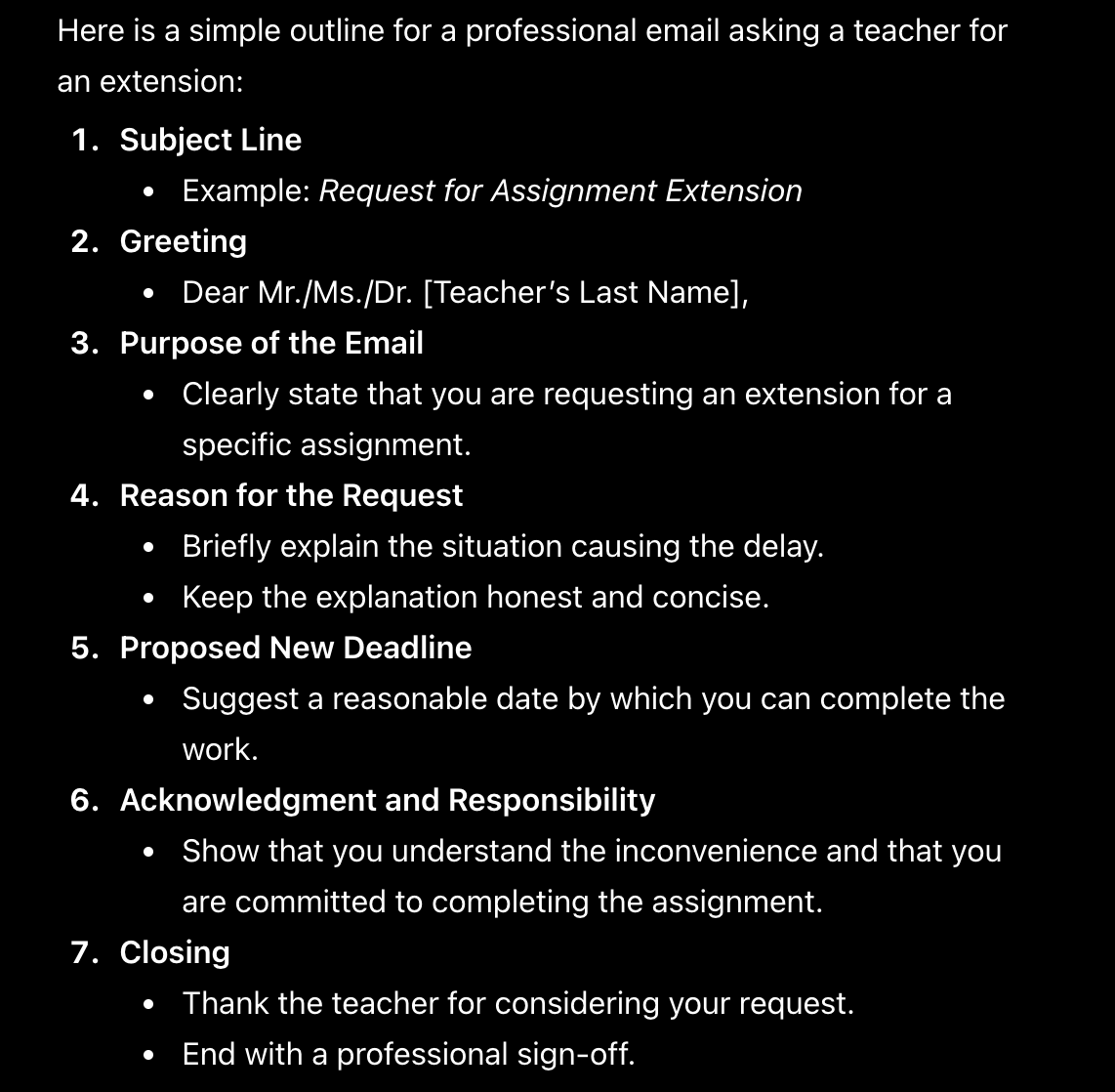
  • Give me an outline of a professional email to a teacher asking for an extension.
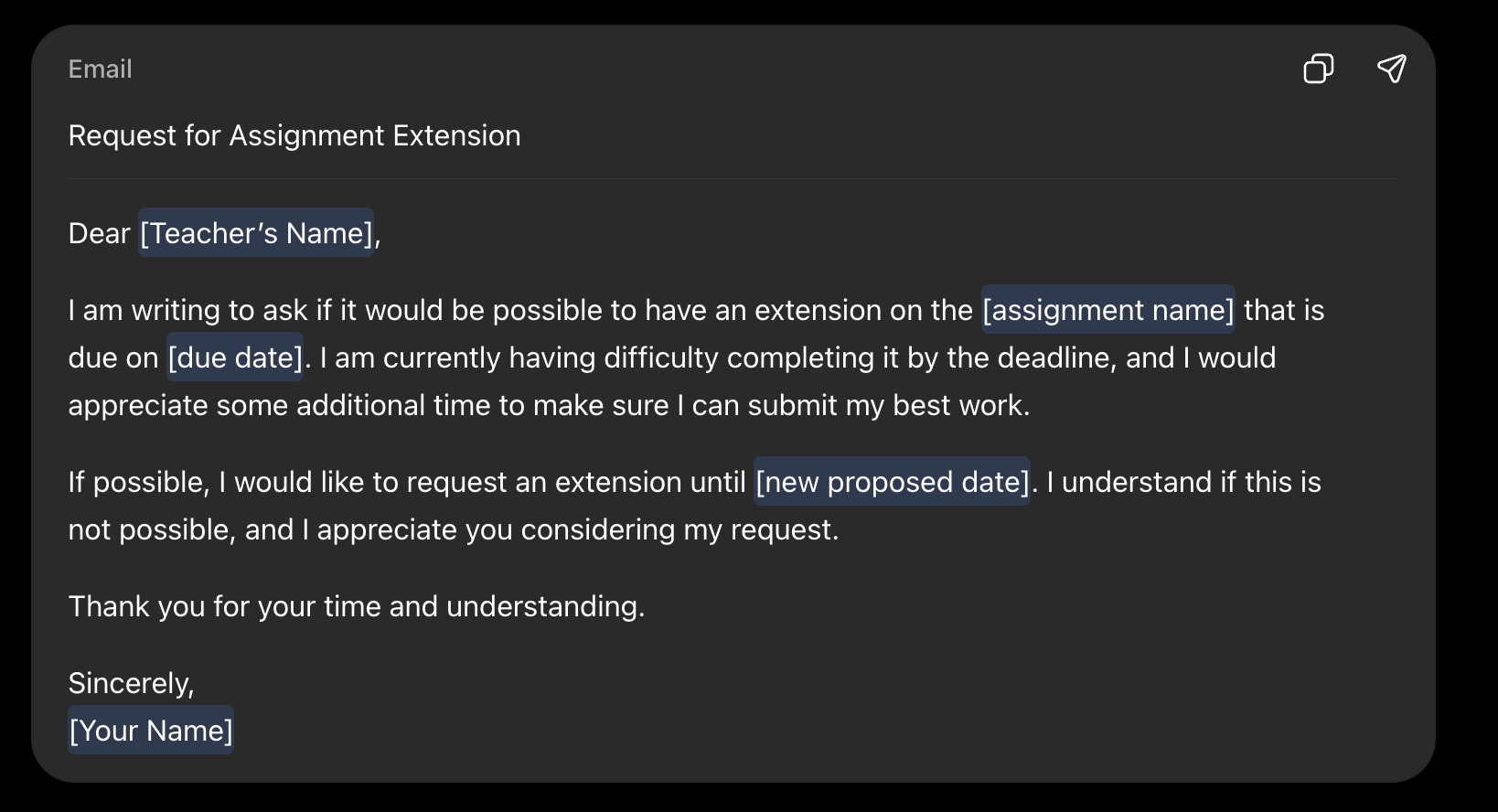
  • Write me a professional email to a teacher asking for an extension.

Image for Prompt 1- It outlines what I need to do and has me still format and learn how to write an email. It gives me a simple outline instead of guessing what I want to say, how I speak, the environment I’m in, etc.

Image for Prompt 2- It writes it for me and interestingly gives an excuse of just having “difficulty completing”.  It assumes the situation; I could be sick or injured. It fully chooses the format and tone of the message. 

This takes me into how I would use or not use AI in academics for the future. I like how it gives an outline; this could be related to finding key points in reading. I can then do the reading and look for these ideas to focus on, but also find things in the reading on my own. I would not have it do the reading for me, or, connected to my example, write my email, because then I do not control what I am taking from the reading and am not learning on my own.

Through this process, I have further supported my opinion on not wanting to use AI in academics. As we continue to test prompts and learn the inner workings of LLMs, I further wish to rely on myself. We have proven in class that our brains are more helpful than a fake one. We learn through ours, remember through ours, and we most importantly think.

WORKS CITED

Nataliya Kosmyna et al, MIT Media Lab (2025). Your Brain on ChatGPT: Cognitive Debt when Using an AI Assistant for Essay Writing Task

Image 1. Screenshot of ChatGPT response to “Give me an outline of a professional email to a teacher for an extension” prompt.

Image 2. Screenshot of ChatGPT response to “Write me a professional email to a teacher asking for an extension” prompt.

What is AI plan? Post 3: LLMs (week 4)

Before this week of class, I had no idea what the exact purpose of an LLM (Large Language Model) was. I also didn’t know it was the main backbone for generating answers in key AI apps, like ChatGPT and Copilot. The most interesting fact I found out was how it actually operates. The input text is split into smaller units called tokens, which can be words, subwords, or characters. Then those tokens are turned into an answer that represents semantic meaning. Also, the video where it visually showed the breakdown of the process was very interesting and something I would’ve never guessed went down.

One perspective that has changed about AI is the use of environmental resources required to operate it. My main issue is the energy and carbon emissions. As we know, training and running AI models require large -scale computing, increasing greenhouse gas emissions. This is a fact that has been talked about in almost all of my classes, which means it is a pressing matter for everyone constantly using AI and those who are being affected by this.

Going off of that statement, one practical application that I plan to use in my academic work is to encourage responsible AI usage. I will limit unnecessary high-energy tasks, such as large-scale image or video generation, and promote energy-aware AI design.

3Blue1Brown (2024, April 1). Transformers, the tech behind LLMs. Dftba Records. Transformers, the tech behind LLMs | Deep Learning Chapter 5

The Wonderful Statistical World of LLMs

The most interesting thing I learned about LLMs was how GenAI can not only produce bias information but also that overall A.I. bias can be more extreme than real-world bias. This was covered in Jon Cheung’s article for The London Interdisciplinary school. I think most people don’t really think about what a generative A.I. model is really doing when it’s asked to make an image. What makes it worse it the fact that the biased images the generative A.I. produces that are uploaded to the internet will then by fed back to it. For example, if you ask an image generator for a series of pictures of CEOs there is high chance that it will mostly produce a mid 40s white make in suit standing and smiling in a boardroom. If you upload that to the internet that those images can then be used to train the same or another A.I. image generator.

Another interesting thing was learning how exactly the token system worked. I didn’t know that A token is not always a full word. It definitely can be a whole word but it can also be a fragment of a word, a phrase, or individual letters. Then the text generation happens using the probability distribution across every token in its vocabulary for what should come next. Real good semi-complicated stuff.

In terms of my uses for A.I. I only plan to use it for organizing/ summarizing given information. I don’t use it for anything outside of that.

Citations/Sources

Cheung, J. (2023, August 21). How AI image generators make bias worse. London Interdisciplinary School. https://www.lis.ac.uk/stories/how-ai-image-generators-make-bias-worse

3Blue1Brown. (2024). Transformers, the tech behind LLMs | Deep Learning Chapter 5, YouTube. https://www.youtube.com/watch?v=wjZofJX0v4M

Declaration of AI Use: No generative A.I. was used in the writing of the blog post, nor for grammar.

Understanding AI In This New Day of Age By: Kaleel Thomas

What happens when you hand a machine your sources and ask it to do the reading for you? That question sat at the center of our unit on language-model research tools, and the answer turned out to be more complicated, and more interesting, than I expected. In this post I want to share the one takeaway that stuck with me after working with Google’s NotebookLM: understanding how these tools work isn’t optional anymore. The technology keeps changing, and knowing how to use it well is quickly becoming as basic as knowing how to search a library catalog.

MAjor Takeaway

This week has been my favorite when it comes to learning about LLM( Large Langauge Models). It was especially interesting to learn about how AI breaks down the inputs we subimit into what the video called Token. Futhermore token in the context words the word itself or small pieces of the word. In the context of a image the patches of image would consider a token. These tokens are directly associated with a vector. A Vector is simply a sequence of numbers, and they are meant to encode whatever piece of token is submitted. Then the vectors are passed through an attention block, which allows the vectors to talk to each other to update values. Another key takeaway is understanding transformers and that LLMs can only produce a prediction for what comes next in the passage.

Another major takeaway from this week in understand how to use and prompt your AI. Closer to the end of the week, from the UT article, we learned very important and, I said helpful ways to prompt AI to get the best output. For example when prompting AI know what the capabilities are, be specific, provide an example, and refine the output

Surprise and Game changing information

The most surprising thing from this week for me is understanding the capabilities of certain AI platforms. In class, we submit a very vague prompt, and each platform produces a different output. Seeing how certain AI can do so much more with such little information is very cool in my opinion. Furthermore, reading the article about generative AI producing biased images was extremely fascinating to me because I honestly have never known that AI was doing such a thing and pushing already existing stereotypes. I really like the part in that article where it talks about the philosophical question of how we ” define bias” and “fairness”.

NotebookLm/ Gemini Notebook

.You upload your own sources, such as PDFs, articles, videos, and notes. The tool answers only from those sources and cites the exact passage behind every claim. That makes its answers easy to check. Because it reads many sources at once, it can compare them, find connections, and summarize them in ways that would take hours by hand.

Submitted a prompt to Claude
Prompt: ” Give me a running model

Declaration of AI Use: “I used Claude (Anthropic) on September 7, 2026 to [generate the Three.js code for the runner game / draft a description of a swimmer / animate an SVG runner]. I [edited, tested, and directed the output / wrote the final version myself]. Prompts and outputs are available on request.”

Text/ Video cituation: Bender, Emily. “Don’t Try to Get Answers from a Stochastic Parrot.” YouTube, uploaded by Harvey Mudd College, 2024, www.youtube.com/watch?v=5m0ZolIb2hA. 2024 Nelson Speaker Series.

Cheung, Jon. “How AI Image Generators Make Bias Worse.” London Interdisciplinary School, 21 Aug. 2023, www.lis.ac.uk/stories/how-ai-image-generators-make-bias-worse.

Sanderson, Grant. “Transformers, the Tech behind LLMs | Deep Learning Chapter 5.” YouTube, uploaded by 3Blue1Brown, 1 Apr. 2024, www.youtube.com/watch?v=wjZofJX0v4M.

University of Texas System. Prompt Literacy. UT Aspire, Nov. 2025, www.utsystem.edu/sites/default/files/documents/general-documents/2025/ut-aspire-prompt-literacy/ut-aspire-prompt-literacy.pdf. PDF download.

LLMs My Major Takeaway + Thoughts

My main takeaway from this week’s classes, simply put, is that the user’s input dictates the majority of the Large Language Model’s (LLM) output. If LLM users want to produce intended results, they need to be specific in their prompts. This includes detailing the audience, message intention, and other contextual matters. An important practice to create an optimal output is to use follow-up prompts. LLM’s are tools, not sentient beings, and must be instructed.

I really appreciated the quick lesson on why transformers matter and how they sequence words. This video can be found here. I found the theoretical visualization to be fascinating. In reality, though, it’s disheartening to imagine the energy required as data collection continues. This week, Adam brought up some great points regarding AI and environmental concerns. I find that notion to be exceedingly important as scholars continue to test, explore, and/or influence AI’s strengths and weaknesses.

A visual representation of a transformer

Another ethical concern from this week’s classes was about how LLMs can perpetuate human biases at an accelerated rate. As discussed above, LLMs are dictated by their input, and this includes the input of data that they are built trained and trained on (Cheung). Unfortunately, humans hold all types of ignorant biases toward each other. Consequently, as stochastic parrots, LLMs will simply repeat harmful messages unless specifically regulated. Even worse, when prompted to generate images of people, LLM’s tend to depict typical stereotypes. For instance, they will show doctors as white males or dark-skinned Barbies as violent. In today’s age, all consumers must be exceedingly mindful of the products they consume. Especially with regard to products akin to LLM’s that provide quick results.

Cheung, Jon. “How AI Image Generators Make Bias Worse.” LIS, 21 Aug. 2023, lis.ac.uk/stories/how-ai-image-generators-make-bias-worse.

3Blue1Brown. “Transformers, the Tech behind LLMs | Deep Learning Chapter 5.” YouTube, 10 Sept. 2026, www.youtube.com/watch?v=CJ-BY-rQrVM.

Grammarly was used for spelling and grammar purposes.