Module project report: DH ethics

BY: Kaleel Thomas

Module Project Template

This semester we covered a lot when it comes to data collection, privacy, the environment, bias in generative AI, and so much more. Covering these vital topics in regard to generative AI has recently made me pose a question to myself: what are some concerns I am going to face when doing this digital research project?

To add more context, my DH project is on the representation of Black athletes vs. white athletes during the civil rights period. I had to narrow it down to a more specific question: “How accurately do LLMs represent well-known Black athletes compared to well-known white athletes from 1954 to 1968, the years of the civil rights movement, and was either group’s representation minimized or distorted because of that time period?”

When I reflected on everything we have read, the first concern that came to mind was the environmental impact this project is going to have. When reading “Explained: Generative AI’s Environmental Impact,” I became aware of how much generative AI is damaging the environment. Adam Zewe reports that “the power requirements of data centers in North America increased from 2,688 megawatts at the end of 2022 to 5,341 megawatts at the end of 2023, partly driven by the demands of generative AI” (Zewe). That is almost double in just one year. My project alone won’t use anywhere near that much, but since I am using three different LLMs to get information on the same athletes, every prompt I send adds to that demand. Each token you submit to an LLM uses resources from the earth. I feel a bit of cognitive dissonance because I know this has a cost, but I am still going to do it so I can test which LLMs spit out fake sources and which give us actual information. To counteract this, I will refine my prompts for each LLM so I can limit the amount of harm I’m doing to the environment.

My project is also about who gets left out, which connects to inclusive design. In an article on inclusive design principles, Carla Gonzalez Cidoncha writes that “digital products are often designed with a narrow definition of the ‘typical’ user in mind” (Gonzalez Cidoncha). If the people and data behind an LLM have a narrow idea of whose history matters, then the tool might give detailed answers about white athletes and thin or wrong answers about Black athletes. That is exactly what I want to find out.

The other obstacle I might face is finding information on these athletes. Even though UA has a large archive, right now I can’t find anything but newspaper coverage of events that happened, with no real information about the players’ careers. Because of this, I told myself not to limit myself to sources from UA.

Works Cited

Gonzalez Cidoncha, Carla. “Inclusive Design Principles: How to Build Digital Experiences That Work for Everyone.” iubenda, 19 Mar. 2026, www.iubenda.com/en/help/181591-inclusive-design.

Zewe, Adam. “Explained: Generative AI’s Environmental Impact.” MIT News, Massachusetts Institute of Technology, 17 Jan. 2025, news.mit.edu/2025/explained-generative-ai-environmental-impact-0117.


The sun setting through a dense forest.
Wind turbines standing on a grassy plain, against a blue sky.

Project proposal

Final project proposal

L
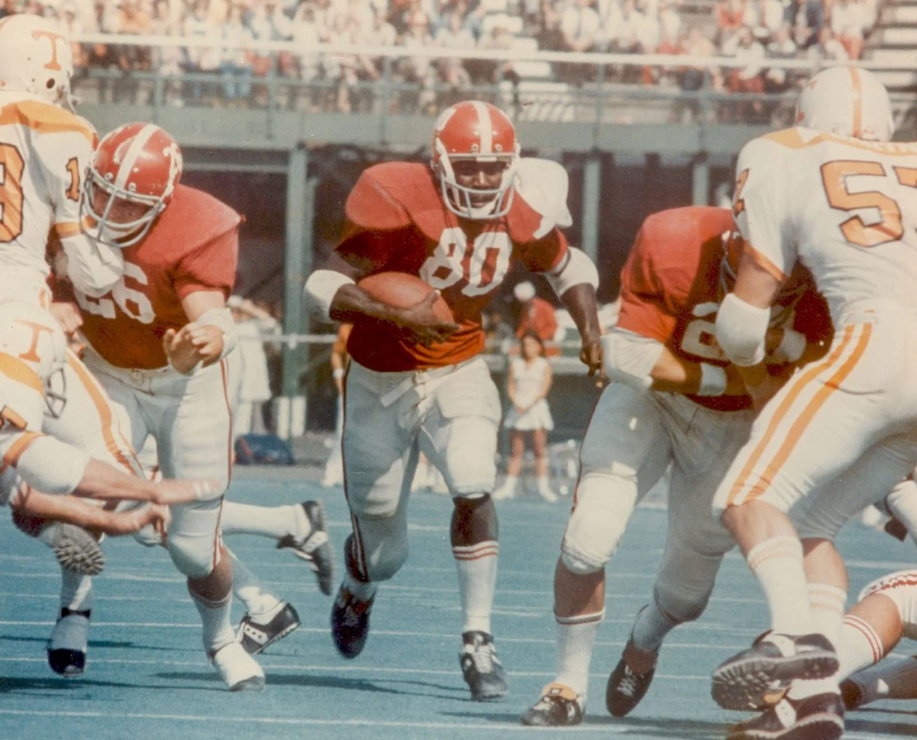
This Wilbur Jackson of University of Alabama a very well known black athlete

My final project is on the representation of Black athletes but more specifically, the digital humanities question is “How accurately do LLMs represent the Black athletes who integrated University of Alabama sports, and are lesser-known figures more likely to be erased or distorted than the famous narratives around them?” The digital method that I am going use is data analysis. However, to elaborate more, I am going to look up well-known Black Alabama athletes and lesser-known ones from 1954- 1968, then ask three LLMs to give me information on their careers and the events they attended. Then fact checking the information that it gives me by going through Alabama digital archives. I am evaluated which LLMs give me fake information, or what we refer to in class as hallucinations.

I chose to focus on the period from 1954 to 1968 because it spans the heart of the civil rights movement, from the Brown v. Board of Education decision to the assassination of Martin Luther King Jr. and the passage of the Fair Housing Act. I wanted to explore whether representation shifted during these years as a result of the struggle for civil rights. Did growing public pressure, protest, and legal victories lead to more frequent or more respectful portrayals of Black Americans? Or did backlash and resistance to change cause that representation to diminish?

For four years, I stepped onto the wrestling mat and looked around at a sport where I rarely saw anyone who looked like me. Wrestling has long been dominated by white athletes, and match after match, tournament after tournament, the absence of Black wrestlers was impossible to ignore. It hurt to feel like an exception in a sport I loved. That feeling is what drew me to this topic. It also made me wonder whether this imbalance was new or had deep roots in a history most people never talk about.

Cite information: “Wilbur Jackson.” Photograph. Courtesy of the Paul W. Bryant Museum, University of Alabama. Encyclopedia of Alabama. Alabama Humanities Alliance. Accessed September 24, 2026. https://encyclopediaofalabama.org/media/wilbur-jackson/.

Module 2 LLM’s Unit report – Yea I said it I’m PRO AI in College!!

AI reinforces ideas, not replace them

This week was an especially interesting week after reading the MIT report on generative AI in higher education. The study showed that, over a long period of time, students who relied on LLMs to do work for them had weaker EEG brain connectivity compared to the second group (Brain to LLM). Their EEG brain connectivity was much stronger due to their memory storage being stronger, as they actually applied themselves to understand the topic at hand. However, instead of looking at this as a bad thing, we can use this report to change generative AI for not only the betterment of the student but also people in the world. Students should use generative AI in their college studies, but in an ethical way. Instead of creating generative AI that spits out answers, there can be generative AI that guides students to the answer in the same way a tutor would. Nevertheless, there is an example of this already happening at Harvard University. They have an AI tutor embedded in a course called “CS50 Duck,” Harvard’s introductory course.

In order to embed generative AI into college academics, we have to do as it says in the MIT report: “redesign AI to guide instead of answer”. I wanted to use Harvard’s AI design model as my foundation to create something bigger, something that will not only help students with their work but also inform students on the importance of using AI responsibly to utilize fewer resources to negate the harm to the environment. “Brain connectivity systematically scaled down with the amount of external support”. Seeing this to be true in teh article, as well as when we did a sample experiment in class. In order to prevent that, I wanted to create an AI tool/app similar to CS50 Duck in Claude. When formatting my prompt, I made sure I followed the four steps to create an effective prompt to produce the best output. Follow the four most important rules when prompting AI, which are: ADD context and motivation, be clear and direct, use examples, structure the prompt, and give the model a role.

Building The Socratic Margin that an LLM’s behavior is mostly a design decision rather than a fixed property of the model, since the same system that will hand a student a finished essay will also refuse to if you build the refusal into the tool instead of politely asking the model for it. I learned that instructions alone are not a guardrail: my prompt tells the tutor never to write out the work, but the page itself also strips any worked-out block before it reaches the screen, and it is that second layer, not the first, that actually holds when a user pushes. As a maker, I found that my hardest decisions were pedagogical rather than technical, because deciding that the student and not the AI controls when the hints get stronger, and that the “climb a rung” button stays locked until the student has written something real, took far longer to reason through than any of the code did. On ethics and inclusion, I realized that a tutor that withholds answers is only fair if it meets students where they actually are, which is why the ladder changes its vocabulary by subject and by level instead of assuming every student arrives with the same preparation. In the larger digital ecosystem, this method of building a small, constrained, single-purpose AI tool works as a counterweight to general-purpose chatbots, and it suggests that the most valuable work in educational AI may be narrowing what a model is permitted to do rather than expanding it. Going forward, I would test the tool on other students instead of on myself, because I currently have no evidence that my hint ladder produces the “productive struggle” the MIT report calls for rather than simply a slower path to the same frustration.

Artifacts

This helps with creating effective prompt to utilize less resources

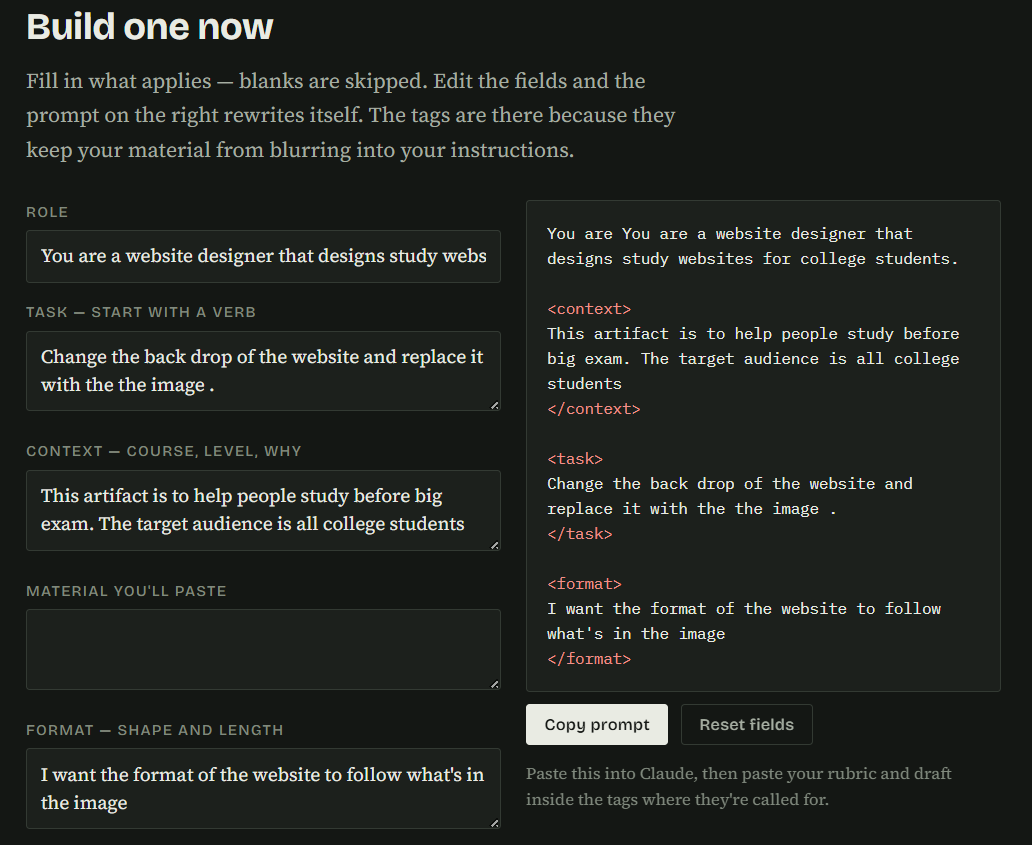
There are two different artifacts that are being displayed here which are the Socratic Margin & my Build One now prompt agent

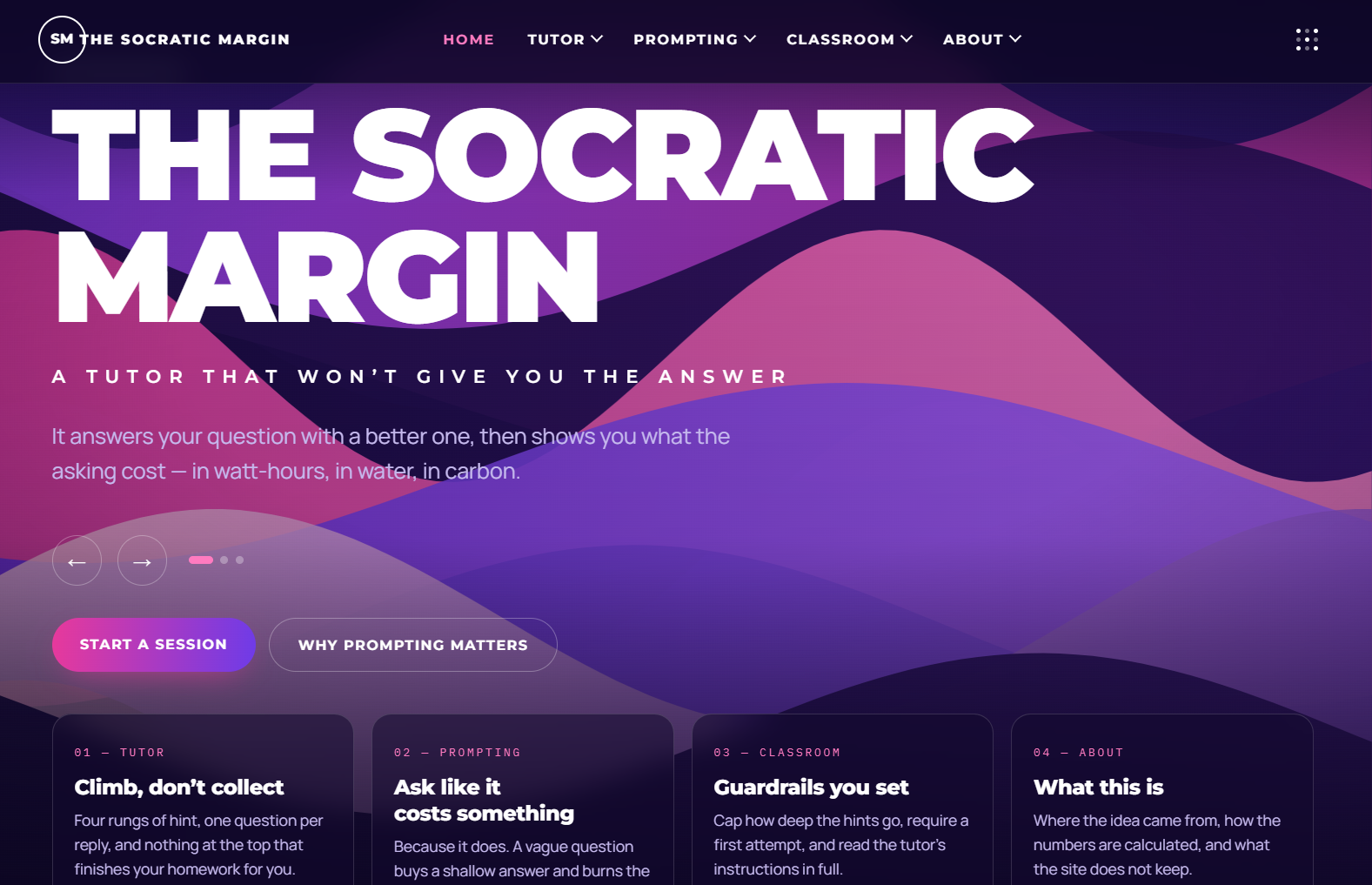
The Socratic Margin- This a website I created through the LLM Claude. This website lets you submit any academic material and asks you three questions. What you’re working on, what you tried, and where it stops making sense. Futhermore when you submit your content it breaks down what you dont understand step by step. This website also has a drop down tab to inform everyone on why prompting matter and the importance of prompting as well.

Prompt to create website: You are a website designer that designs websites for teachers and students. Your job is to create an AI tool that acts as a tutor instead of spitting out answers.

<context>
This AI tool should be similar to (CS050) that is a generative AI used for an intro course at Harvard University
</context>

<task>
Generate an AI tool that acts as a tutor to anyone and helps them guide them to get the answer, and furthermore informs them of the importance of effectively prompting to utilize fewer resources to negate the harm to the environment)
</task>

<format>
I want this to be formatted as a website that has (colors that are visually appealing to said audience.
</format

I create this prompt through my prompting kit, which is the Build one now agent that helps you create prompt to produce the best outputs. Using what we learn from the readings on prompting.

Cituation: Ad Hoc Committee on AI Use in Teaching, Learning, and Research Training. Report of MIT’s Ad Hoc Committee on AI Use in Teaching, Learning, and Research Training. Massachusetts Institute of Technology, 13 Aug. 2026, aiandeducation.mit.edu/report/.

Anthropic. “Prompting Best Practices.” Claude Platform Docs, platform.claude.com/docs/en/build-with-claude/prompt-engineering/claude-prompting-best-practices. Accessed 20 Sept. 2026.

Declaration of AI usage:I acknowledge the use of Generative AI tools in creating these artifacts: I used Claude to write the code for both tools from my own design specifications, and both artifacts call Claude at runtime to generate the tutoring dialogue.

Understanding AI In This New Day of Age By: Kaleel Thomas

What happens when you hand a machine your sources and ask it to do the reading for you? That question sat at the center of our unit on language-model research tools, and the answer turned out to be more complicated, and more interesting, than I expected. In this post I want to share the one takeaway that stuck with me after working with Google’s NotebookLM: understanding how these tools work isn’t optional anymore. The technology keeps changing, and knowing how to use it well is quickly becoming as basic as knowing how to search a library catalog.

MAjor Takeaway

This week has been my favorite when it comes to learning about LLM( Large Langauge Models). It was especially interesting to learn about how AI breaks down the inputs we subimit into what the video called Token. Futhermore token in the context words the word itself or small pieces of the word. In the context of a image the patches of image would consider a token. These tokens are directly associated with a vector. A Vector is simply a sequence of numbers, and they are meant to encode whatever piece of token is submitted. Then the vectors are passed through an attention block, which allows the vectors to talk to each other to update values. Another key takeaway is understanding transformers and that LLMs can only produce a prediction for what comes next in the passage.

Another major takeaway from this week in understand how to use and prompt your AI. Closer to the end of the week, from the UT article, we learned very important and, I said helpful ways to prompt AI to get the best output. For example when prompting AI know what the capabilities are, be specific, provide an example, and refine the output

Surprise and Game changing information

The most surprising thing from this week for me is understanding the capabilities of certain AI platforms. In class, we submit a very vague prompt, and each platform produces a different output. Seeing how certain AI can do so much more with such little information is very cool in my opinion. Furthermore, reading the article about generative AI producing biased images was extremely fascinating to me because I honestly have never known that AI was doing such a thing and pushing already existing stereotypes. I really like the part in that article where it talks about the philosophical question of how we ” define bias” and “fairness”.

NotebookLm/ Gemini Notebook

.You upload your own sources, such as PDFs, articles, videos, and notes. The tool answers only from those sources and cites the exact passage behind every claim. That makes its answers easy to check. Because it reads many sources at once, it can compare them, find connections, and summarize them in ways that would take hours by hand.

Submitted a prompt to Claude
Prompt: ” Give me a running model

Declaration of AI Use: “I used Claude (Anthropic) on September 7, 2026 to [generate the Three.js code for the runner game / draft a description of a swimmer / animate an SVG runner]. I [edited, tested, and directed the output / wrote the final version myself]. Prompts and outputs are available on request.”

Text/ Video cituation: Bender, Emily. “Don’t Try to Get Answers from a Stochastic Parrot.” YouTube, uploaded by Harvey Mudd College, 2024, www.youtube.com/watch?v=5m0ZolIb2hA. 2024 Nelson Speaker Series.

Cheung, Jon. “How AI Image Generators Make Bias Worse.” London Interdisciplinary School, 21 Aug. 2023, www.lis.ac.uk/stories/how-ai-image-generators-make-bias-worse.

Sanderson, Grant. “Transformers, the Tech behind LLMs | Deep Learning Chapter 5.” YouTube, uploaded by 3Blue1Brown, 1 Apr. 2024, www.youtube.com/watch?v=wjZofJX0v4M.

University of Texas System. Prompt Literacy. UT Aspire, Nov. 2025, www.utsystem.edu/sites/default/files/documents/general-documents/2025/ut-aspire-prompt-literacy/ut-aspire-prompt-literacy.pdf. PDF download.

Hip-Hop hit the ground running and never looked back

Hip-Hop hit the ground running and never looked back.

Created by: Kaleel Thomas

When I first clicked into the folder for the project dataset options, within seconds the first things that piqued my interest were “spotify” and “aggregated genre by year total streams”. I knew from that point I wanted to explore this dataset. Diving into this dataset, I already knew I wanted to do something closely related to the genre of Hip-hop, so the question I decided to ask was who led in overall streams for the years 2010-2023. I wanted to use this data to not only understand who is dominating the streams between the two but the gaps in streams as well. However, I did consider questions such as how the data is represented, whether any group is unrepresented, and my own personal question:s can a song belong to more than one genre. This is because there have been multiple instances where rap artists and rock artists collab to make a song.

When working to visually represent my dataset, I used Flourish to visualize the data. The first thing I did was take the information from the Excel sheet and put that directly into Flourish. Initially, I wanted to use a pie chart to represent my data, but then I found it was not visually comprehensible. Furthermore, I remember when looking at the types if graph before class that, when doing comparison it is better to use a line graph. Furthermore, I had to adjust the Excel sheet information to only have the year and streams for the genres rap and rock music. Then, resubmitted the data back to Flourish to get a better line graph. The obstacle I ran into was the coloring of the graph because I wanted the background to be black for my graph, but it was just not visually appealing. From here on, after multiple tries, I pivoted, and I attached my Claude to my Flourish to clear up the formatting. What surprised me during this process was how easy it was for the AI to take what I initially created and clean it up so fast to make it visually appealing.

Iryna Tokarchuk. Top Streamed Spotify Songs by year 2013-2023.”
 https://www.kaggle.com/datasets/irynatokarchuk/top-streamed-spotify-songs-by-year-2010-2023 

 “The formatting of my Flourish line graph in Section 3 was cleaned up with Claude Fable 5.1 (Anthropic) using the prompt: ‘Clean up the formatting of this line graph so it is visually appealing.’ I built the chart and selected the data myself; Claude adjusted the colors, title, and subtitle styling, and I reviewed the final chart for accuracy

Introduction: Kaleel Thomas

“K. Thomas, personal photo ( August 2026)”