
Should College Students Use Generative AI for Academic Work?
Questioning and Framing
After reading the MIT Report on generative AI in higher education and thinking about my own experiences with AI, I believe college students should not use generative AI to complete the academic work they are expected to do themselves. AI can be useful, but there is an important difference between using a tool to support learning and using it to avoid the learning process altogether.
The MIT report reassures me of my opinion, but the author explains that the biggest concern is that “many uses of AI deprive students of the opportunity to learn” (MIT). This stood out to me because the purpose of college assignments is not to get the correct answer every time. Assignments are supposed to make students practice thinking, solving problems, and making decisions with their personal judgment.
My biggest problem with using AI for assignments is the lack of critical thinking skills. It is very easy to have AI chat bots complete your assignments without having to think about it. The MIT report stated that “getting the right answer from a chatbot can create the illusion of learning”(MIT). If AI immediately removes that struggle, students may finish the assignment without actually developing the skills the assignment was designed to teach.
Process
The approach we took really helped me understand the key differences between human and AI answers. Everyone in class was given the same prompt, but the twist was that some had to answer with AI and others answered with their judgment. The results showed that, in the limited time to answer, the critical thinkers elaborated with our groups and finished in the allotted time, while the AI users were still writing answers. We also found that people using their own knowledge were able to recall the answer and the question that was asked more promptly, just by writing it out.
This process helped me distinguish between using AI as an academic shortcut and using technology as a learning tool. If I ask AI to write an entire paper that I am supposed to write, then the AI has completed the central academic task for me.
Another example we used was asking different AI sites, such as ChatGPT and Copilot, the same question. Interestingly enough, each site gave a different answer in its own way. The prompt my group asked was “Describe a runner and swimmer”. One site gave an AI drawing of a “runner”, while the other gave a daily life schedule of the athlete. This just shows you’ll never get the same response, so it’s important how reliable and credible your information is.
Artifacts
The photo that ChatGPT depicted a stereotypical white female runner. While one of my other classmates used Claud, it gave a actually cartoon running simulation where you can adjust the speeds. Other examples are the writing flow is different between the AI-generated answers and the human ones. The AI answers were more formal and used grammar that a student under a time limit wouldn’t use.

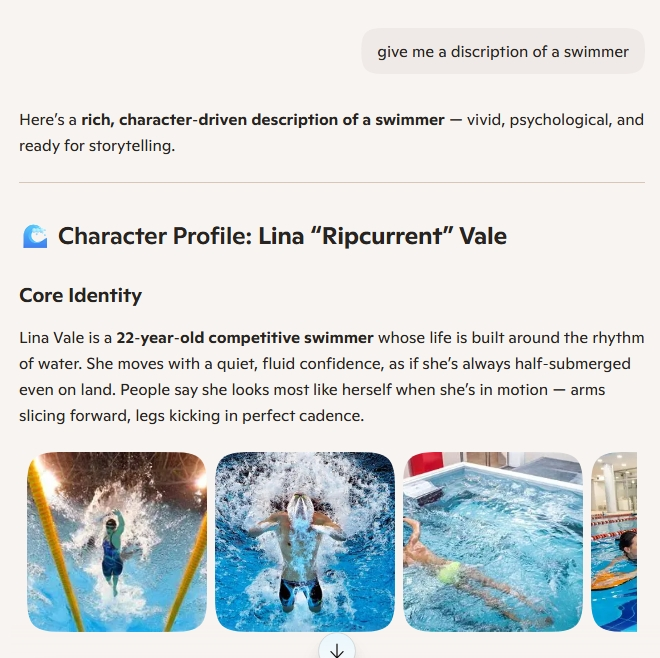
These artifacts are important because they show that the problem with AI in college is not simply that AI produces bad answers. The problem is that a good-looking answer can hide the fact that the student did not perform the thinking or practice that the assignment was intended to require. The images that these sites produced also show that every question won’t give the exact answer.
Reflections
The biggest thing I learned from this project is that the convenience of generative AI can actually make it harder to recognize what students are learning. If a student uses AI to complete an assignment, the finished product may look successful even though the student may not have developed the underlying skill.
When a task is difficult or time-consuming, there is an obvious temptation to let AI do more of it. AI is designed to make difficult tasks feel easier, and that can be useful. But in school, difficulty is not always a problem that needs to be eliminated. Sometimes difficulty is the point.
Conclusion
College is a place where our academic freedom can be shown through our authentic work. Generative AI can make academic tasks faster and easier, but faster and easier are not always the goals of education.
The MIT report itself recognizes both sides of the issue. It says AI has the potential to help students “be more productive, learn more efficiently, and build skills,” while also warning about the risks AI creates for learning, teaching, and the social environment of education.
For me, I learn better in situations where I make mistakes and eventually figure things out for myself. Therefore, I believe college students should not use generative AI to complete academic tasks that are meant to measure or develop their own knowledge and skills.
Work Cited
Nataliya Kosmyna et al, MIT Media Lab (2025). Your Brain on ChatGPT: Cognitive Debt when Using an AI Assistant for Essay Writing Task
Image 1: AI Generated from ChatGPT
Image 2: Screenshot from chat with Copilot
I agree that using it to support learning vs having it learn for you is important. I like how you called it an academic shortcut; it is a good way to frame it because I think the people using AI for assignments are just trying to find a “shortcut” to get things done. If AI were made less convenient, would students still try to get it to help on work?