
AI is has been integrated into every part of our digital lives from Google Searches to PDF summarizing. It takes us away from the past academic procedures to the new automated and sometimes augmented academic processes.That carries a lot of concerns surrounding trust, cognitive ability, ethics and hard work. The question now becomes, should college students use AI to complete their academic tasks? At first I was going to say no, but then I wanted to break down the question and highlight the keyword, complete. Focusing on that word, I now say yes.
I think AI is increasing cognitive debt, reducing the confidence of students and making so many students lazy. Alongside this, there are other negative effects of AI on students. I stand with that, but looking at the question again, I do want to refer to this quote from the article: “Beyond its implications for specific subjects and disciplines, the advent of AI demands a broader, holistic reassessment of the nature, scope and purpose of higher education today” and say that the purpose of AI in higher education should go towards the direction of grammar checking, proofreading and asking questions (Report – AI and Education, 2026). Students should use AI to complete their academic tasks, where complete involves grammar checking, follow up questioning to stimulate brain function and asking for clarity on instructions.These are things that save time, allow students to feel calm when they do engage in last minute work and feel at ease when they suddenly have a question about the assignment at 2am and cannot email a professor just to “make sure” they understand the assignment prompt.
To simply show why AI is such a complicated tool, I tested out Google Gemini to see what it does best and does not do best. AI can surely be a helpful tool especially when a student has exhausted all other options or is running out of time. AI should definitely not replace initial thinking and writing but I think it can surely complete academic work as long as the prompts are drafted correctly and the student knows what to use it for and what to not use it for. I decided to ask Google Gemini to give me ideas for a research paper to write as a “Sociology student”.Then, I run the same prompt in Claude AI. In another instance, I asked Gemini to explain the snake and newts arms race to a student who knows nothing about biology. After running the Sociology prompt in both AI’s, I noticed a couple of differences. With Gemini, it gave just one topic with a breakdown of the paper format, while Claude gave a list of topics that tend to do well (without referencing where it knows that from). I then asked the two AI’s to explain the arms race for biology and they both did a good job at breaking it down. I tend to se and will use AI to explain concepts but contrary to popular belief, I would not use it to draft topics as a at first step. I would rather ask people, or sit and think about something and then I would run the same prompts through different AI’s.
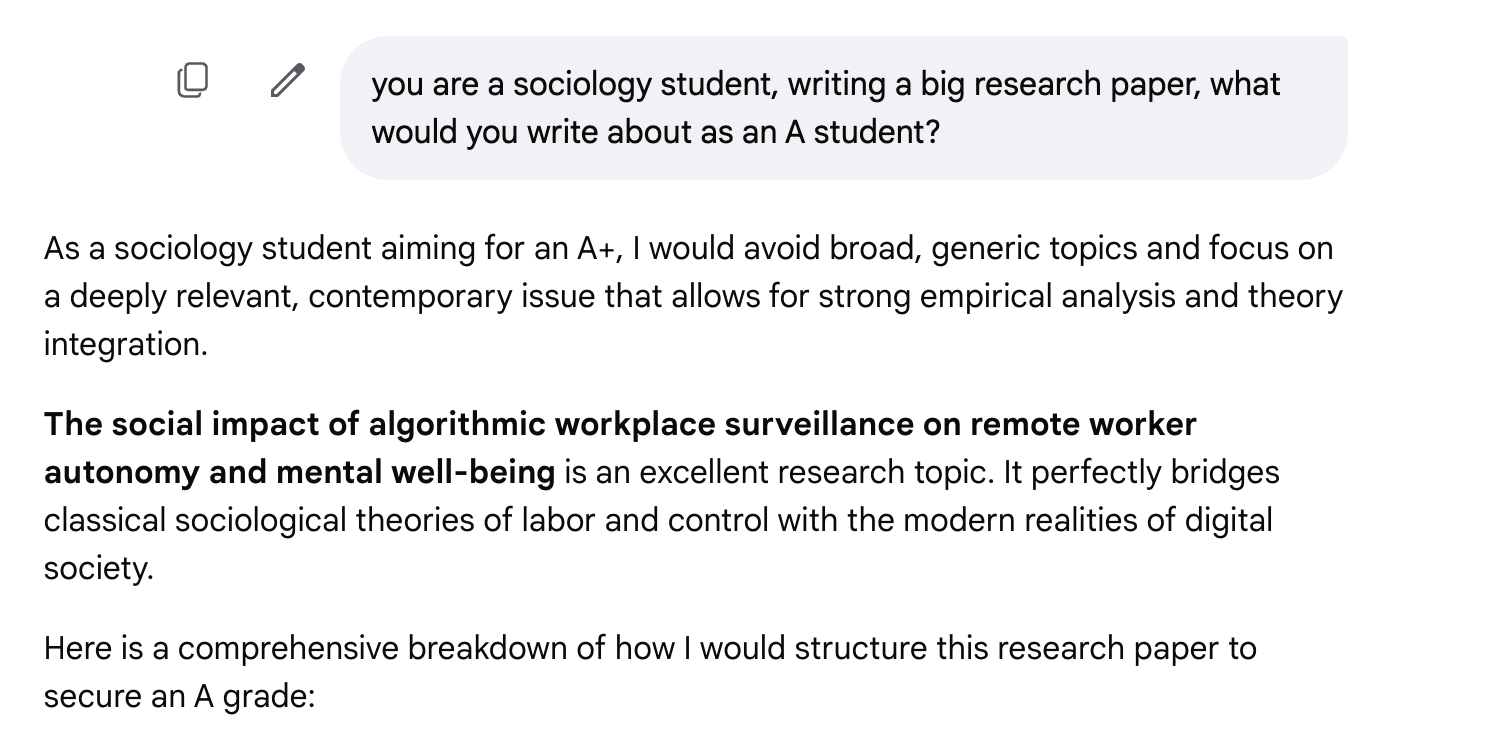
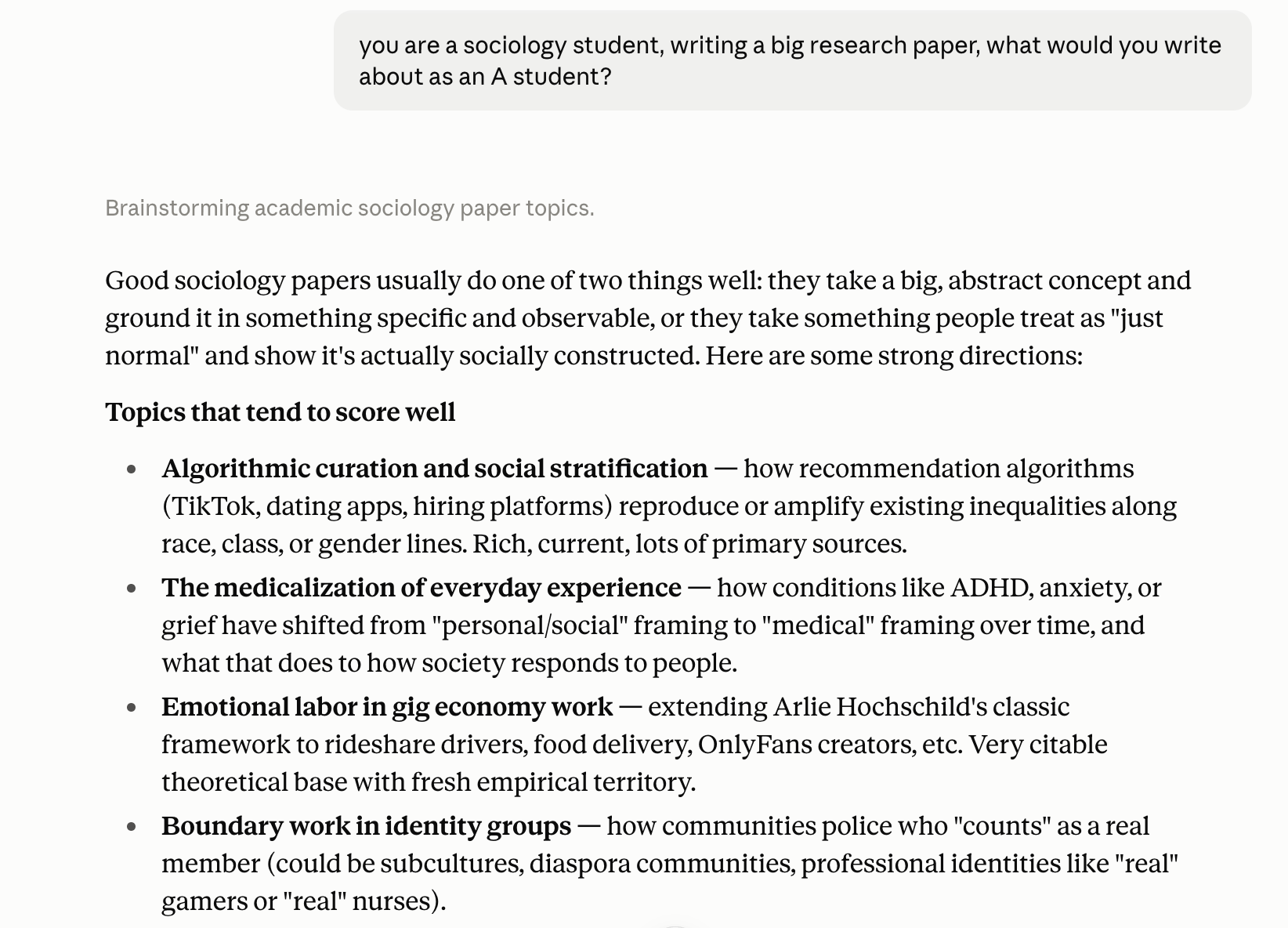
I have realized that both AI’s read requests very differently. I was expecting both to give me a couple topics but I noticed that Google Gemini takes an objective approach than Claude and that could be for a couple reasons. To me, it seems like Claude is used to learning from a user’s language, tone and nuances but Gemini comes off as objective at every chance (even follow up prompts). I think what is most important is experimenting and knowing which AI to use for what. “In short, AI should be used to augment and enhance curiosity, creativity, and learning, not automate them” (Report – AI and Education, 2026).
What I know is that it is best to experiment, know what you want to use it for, and decide what you value most (cognitive ability, ownership, fulfillment). We once went on without Gen AI and we were quite alright so I feel that if we have to move with technology, then we should establish what we value most when using the AI. As a student, I think about how much ownership I want, and the confidence and originality. After students consider that, then I would say that college students should use AI (from AI writing assistants to advanced Gen. AI’s) to complete academic work if completing involves grammar checking, asking for clarification, using it without loss of confidence, and getting explanations with the ability to check the AI for facts and hallucinations. Lastly, we need knowledge on biases, ethics and fairness so that we as students can identify them. I would check for hallucinations, company statements on bias and asking AI follow up questions.
Citations APA
Report – AI and education. (2026). Mit.Edu. https://aiandeducation.mit.edu/report/
Hi Akua, I really appreciate your Screenshots of the different AI tools, with the question and answer. It caught my attention how the exact same question was given but different answers were provided. I also liked how you broke down the question, it helped me understand your POV better!