
The Ethics of Magazine Data Collection

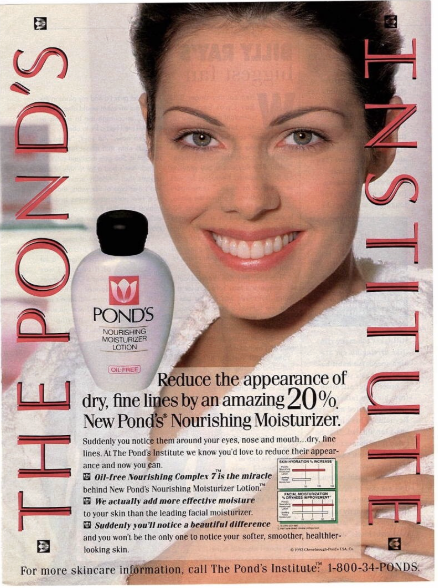
A Ponds Ad from the 1990s illustrating a woman advertising a facial moisturiser
A facial moisturiser ad from the 1990s

At this preliminary stage of my project, I will build a small database of facial moisturizer ads from Cosmopolitan and Essence (or Vogue), two long-running US women’s magazines, from the years 1985, 1995, 2005 and 2025. For each year, I will sample the same editions and collect maybe 5 or 10 moisturizer ads per magazine per year depending on how much is available on the archives and libraries. Each ad will be in a row, with columns for the year, magazine, the brand, who presents the product, who the audience is, health claims and scientific language. I can only document what is explicitly stated at this part of the process. I will then use Flourish to visualize the patterns over time between the two magazines and use Canva to build an exhibit that displays the ads with details, alt text and sources next to it. I will look at the patterns in my sample (the four dates) the presenters, audience, claims, language and how it has shifted over those years and what that suggests about cultural values/norms and others.

In data collection, beng ethical is one of the most important steps to carryout through a project. “When building a data set we need to consider if the source and method we’re using to collect
the information is the most accurate and complete possible” (Barr, 2021). This quote reminded me to think thoroughly about ethical areas that matter most. They would be: data collection, representation, transparency, publishing, context, community representation, accessibility and AI use. When it comes to race, gender, age, I do not want to guess out of the possibility of misrepresenting someone so, i plan to record only what an ad explicitly states or shows in caption or in sources about identity. Transparency is also an ethical area I will address. I want to document everything necessary so that anyone looking at my chart and exhibit can see everything that was done. I plan to structure the spreadsheet such that one row per ad, document my sampling method, any uncertainties or exclusions and why i chose those 4 years.

My Canva exhibit will have real ads, with real people so i ave to give context to the brands advertised. Also with Canva, I will use low resolution but clear images and write captions. Community representation depends on the magazine i use. Right now, I have decided on Essence, which was created for Black women so I want to use that history to also interpret the ads so that I can better explain the beauty standards/cultural norms. I am not trying to use one magazine as a default and the other as an exception for a race conversation.

I want to create a chart and a digital exhibit experience that is inclusive so that it “can be used by as many people as possible”(Cidoncha, 2026). To do that, there are a few things to consider and for now, I pla to add alt text to every ad and the chart, use a dark and light mode version, be mindful of colors and contrasts as well as font size and type. Also, if I use AI at any point, I will double check for facts because AI may misinterpret something about the ad or have a bias as discussed in Gender Shades. I want to do everything myself, to avoid adding to the environmental costs (especially if this is something I can do completely without AI). That is the plan but I will always disclose any AI use at the end to avoid any plagiarism concerns and transparency issues.

Credits: Barr, C. (2021). Building Your Own Data Set: Documenting Knife Crime in the United Kingdom. In L. Bounegru & J. Gray (Eds.), The Data Journalism Handbook: Towards A Critical Data Practice (pp. 49–54). Amsterdam University Press. https://doi.org/10.2307/j.ctv1qr6smr.10

Cidoncha, C. (2026). Page restricted. Iubenda.Com. https://www.iubenda.com/en/help/181591-inclusive-design/

Vintage 1990s magazine print ad the Pond’s Institute skin care Lotion Health V2. (2026, July 10). eBay. https://www.ebay.com/itm/204803412532

AI use: No AI was used to write up this blog post.
Well What is Activism?? – Eric S.

My final digital humanities project will focus on the History of Student Organization Political Activism as reported in the Wooster Voice from 2000 to 2020. For this final project, I will manually read through every publication of the Wooster Voice from the start of 2000 through the end of 2020, identifying political acts from different student organizations and classifying them into two categories: on/off-campus and location (local/regional/national/global). I will create visualizations of this data using Flourish to explore changes in college policy on school-sanctioned student political activism and the political events that drew Wooster students’ attention at the time. This project does have three ethical concerns that need to be addressed: data collection and privacy, community representation, and accessibility/universal design.

I first want to address community representation with this quote from Yau: “You’ve seen how that data can be valuable to an individual. What if you look at the data from many individuals in aggregate?” One main concern with this project is that it does not represent the entire campus community at that time. Because I am sourcing this data from archives of a student newspaper, my research is limited to what the reporters, writers, and editors of the Wooster Voice cared about and were involved in. Another consideration is that the political state of the nation, or even the surrounding Wooster area, also affects what gets reported. So my project is based on the personal lives and interests of the many authors of the Wooster Voice from 2000 to 2020, as well as what I consider to be activism.

As I am the only person working on this project, another thing that I, as well as any reader, must consider is my personal bias. “The easiest way to show off with spectacular data is to fabricate it.”-Kayser-Bril. While I personally have no intention to purposefully misconstrue data in any way, I may inadvertently do so, or the writers of the student newspaper may have. As we’ve seen in discussions of data collection paired with our deep dive into Language Learning Models(LLMs), there is no way to escape bias of any sort. The writers’ personal bias on what to report on and my personal bias on ‘what is activism?’ is what makes this project just a very brief and topical analysis. In order to help circumvent some of my own personal bias, whenever I encounter a story about a student organization and am hesitant on whether or not it is a form of political protest, I will ask either a peer or a person of authority for their opinion. This is not a perfect plan, nor is it free from error or bias; however, it’s the best I got.

OneTrust. (2020). Privacy 101: Data Subject Rights [Video]. YouTube. https://www.youtube.com/watch?v=C3hio0WkRHg

My final consideration is on the presentation of this project in general int terms of who can and/or can view, consume, and understand it. Firstly, when it comes to the design of the data visualizations themselves, I will ensure that the design is inclusive, especially with color and typography. Readability as well as digestibility are the two most important things when it comes to communicating with data. Providing an interpretation for the data is necessary; however, viewers should also be able to understand and draw conclusions from the data themselves. As this project is limited to this class, my personal goal is that it’s accessible to that and similar audiences; this is to say that the project will not be inclusive on a national level.

Citations:

  • Ervin, W. (2013). Data Points: Visualization That Means Something. Nathan Yau. Information Design Journal, 20(3), 294–295. https://doi.org/10.1075/idj.20.3.09erv
  • DataJournalism.com. (2019, February 6). Become Data Literate in 3 Simple Steps. DataJournalism.Com. https://datajournalism.com/read/handbook/one/understanding-data/become-data-literate-in-3-simple-steps
  • OneTrust. (2020). Privacy 101: Data Subject Rights [Video]. YouTube. https://www.youtube.com/watch?v=C3hio0WkRHg
  • Declaration of AI Use: No AI was used in the ideation or construction of this project, gram marly was used to correct grammar.

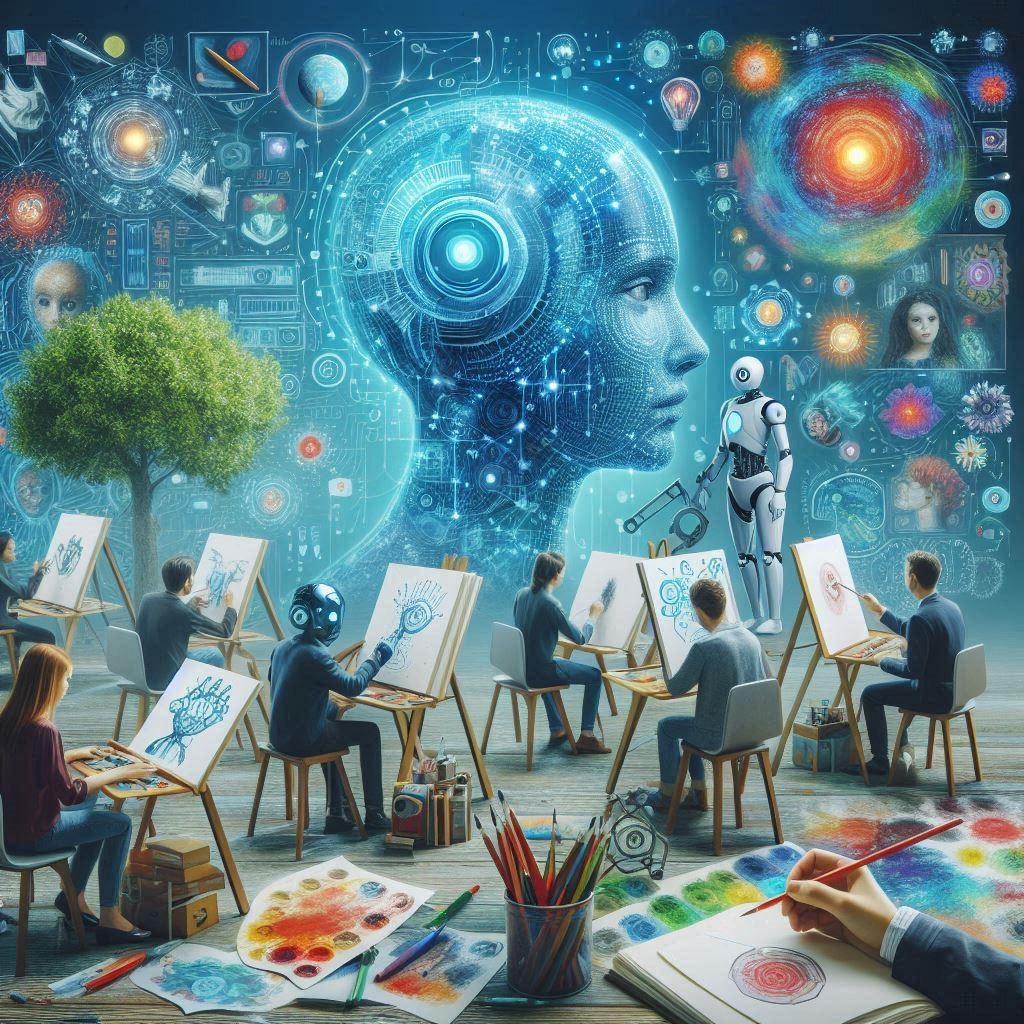
Is ChatGPT the Next Big Artist?

AI USED: Grammarly for spell check.

Shaner, Kyle. “UC Student Explores AI Art Ethics”. UC News, July 31, 2024, https://www.uc.edu/news/articles/2024/07/uc-student-explores-ai-art-ethics.html 

Some ethical and inclusive concerns I have are for those who cannot connect with visual art, such as those with visual disabilities. I am also concerned about language barriers, misunderstanding from non-artists, and those who struggle with brainstorming.

How I plan to address these concerns is by relating how this method could be used for non-visual art such as music, or creating captioning for my images I provide that can then be played out loud. I also want to make it so that there could be a translator applied by using simple language that can be directly translated. For non-artists, I want to explain my process in depth and all that goes into art to show how AI really can affect it. That in turn can also explain my art process and ideas compared to how other artists may do things.

To also connect this to data collection and privacy with ethics, I want to be transparent in my AI usage by stating my prompts, my results, what models I use, why I am using them, and anything else I come across that could be related. It is a concern of mine whether or not the AI will be taking my art and ideas that are entered and using them to train and take them for its own benefit. But this is a concern I can raise to other artists who may not be aware. In the Cornell study I am using as a source, they also mention this is saying, “Accusations of art theft arose surrounding the use of creatives’ works to train these models, as image outputs emulated prominent artists’ styles without their consent” (Campitiello). This highlights my point of concern about my personal art being integrated into the model. All art styles are different, but if the model uses them all to train, then that unique aspect can disappear.

It will also be interesting to see if the different AIs I will use will create different pieces based on bias. Another point is figuring out if AI prompting for art takes more electricity and damages the environment more than an average prompt. To continue this thought, is using AI for planning or referencing plagiarism? Technically, you are not using your own ideas for a starting point, similar to how you may reference a reading in text. These are all things I need to think about further during this process. 

To go with this concern, all that Google’s prompt guide shows for art is the description of its ability. This description is, “Design prompts that specify art styles, techniques, and subject matter to guide the AI in creating images that mimic specific artistic movements or evoke certain emotions.” (Google). The environmental concern for me is that, yes, you can submit a specific prompt as it says, but you will most likely need to refine the prompts and continue prompting. Therefore, it is not a single entry of an image prompt, but something you have to continue to submit multiple times for small fixes that it may not understand or ever fix. It specifically says, “to guide the AI” (Google), showing that you have to continue to give direction to it. We went over this prompt guide in class; however, we didn’t focus on this part of the reading, the part related to images. So in my study, I want to further explore this topic.

To represent the art community, I am referencing sources from other artists doing a similar study to show their ideas on the topic and their differing uses/styles. As I am just one artist out of millions, my ideas are not universal. And for others to test this, I can give prompts and something to try on their own to facilitate community participation.

In reflection of my planning, more concerns have come to me, such as these environmental impacts, how inclusive my work needs to be, and if the AI will take my art style. I will continue to reflect and try to find answers for these as I work.

Campitiello, Jess. “AI vs. Artist: The Future of Creativity.” Cornell Tech, February 20, 2023, https://tech.cornell.edu/news/ai-vs-artist-the-future-of-creativity/ 

“Prompt Engineering: Overview and Guide.” Google Cloud, May 4, 2026, https://cloud.google.com/discover/what-is-prompt-engineering