
AI reinforces ideas, not replace them
This week was an especially interesting week after reading the MIT report on generative AI in higher education. The study showed that, over a long period of time, students who relied on LLMs to do work for them had weaker EEG brain connectivity compared to the second group (Brain to LLM). Their EEG brain connectivity was much stronger due to their memory storage being stronger, as they actually applied themselves to understand the topic at hand. However, instead of looking at this as a bad thing, we can use this report to change generative AI for not only the betterment of the student but also people in the world. Students should use generative AI in their college studies, but in an ethical way. Instead of creating generative AI that spits out answers, there can be generative AI that guides students to the answer in the same way a tutor would. Nevertheless, there is an example of this already happening at Harvard University. They have an AI tutor embedded in a course called “CS50 Duck,” Harvard’s introductory course.
In order to embed generative AI into college academics, we have to do as it says in the MIT report: “redesign AI to guide instead of answer”. I wanted to use Harvard’s AI design model as my foundation to create something bigger, something that will not only help students with their work but also inform students on the importance of using AI responsibly to utilize fewer resources to negate the harm to the environment. “Brain connectivity systematically scaled down with the amount of external support”. Seeing this to be true in teh article, as well as when we did a sample experiment in class. In order to prevent that, I wanted to create an AI tool/app similar to CS50 Duck in Claude. When formatting my prompt, I made sure I followed the four steps to create an effective prompt to produce the best output. Follow the four most important rules when prompting AI, which are: ADD context and motivation, be clear and direct, use examples, structure the prompt, and give the model a role.
Building The Socratic Margin that an LLM’s behavior is mostly a design decision rather than a fixed property of the model, since the same system that will hand a student a finished essay will also refuse to if you build the refusal into the tool instead of politely asking the model for it. I learned that instructions alone are not a guardrail: my prompt tells the tutor never to write out the work, but the page itself also strips any worked-out block before it reaches the screen, and it is that second layer, not the first, that actually holds when a user pushes. As a maker, I found that my hardest decisions were pedagogical rather than technical, because deciding that the student and not the AI controls when the hints get stronger, and that the “climb a rung” button stays locked until the student has written something real, took far longer to reason through than any of the code did. On ethics and inclusion, I realized that a tutor that withholds answers is only fair if it meets students where they actually are, which is why the ladder changes its vocabulary by subject and by level instead of assuming every student arrives with the same preparation. In the larger digital ecosystem, this method of building a small, constrained, single-purpose AI tool works as a counterweight to general-purpose chatbots, and it suggests that the most valuable work in educational AI may be narrowing what a model is permitted to do rather than expanding it. Going forward, I would test the tool on other students instead of on myself, because I currently have no evidence that my hint ladder produces the “productive struggle” the MIT report calls for rather than simply a slower path to the same frustration.
Artifacts
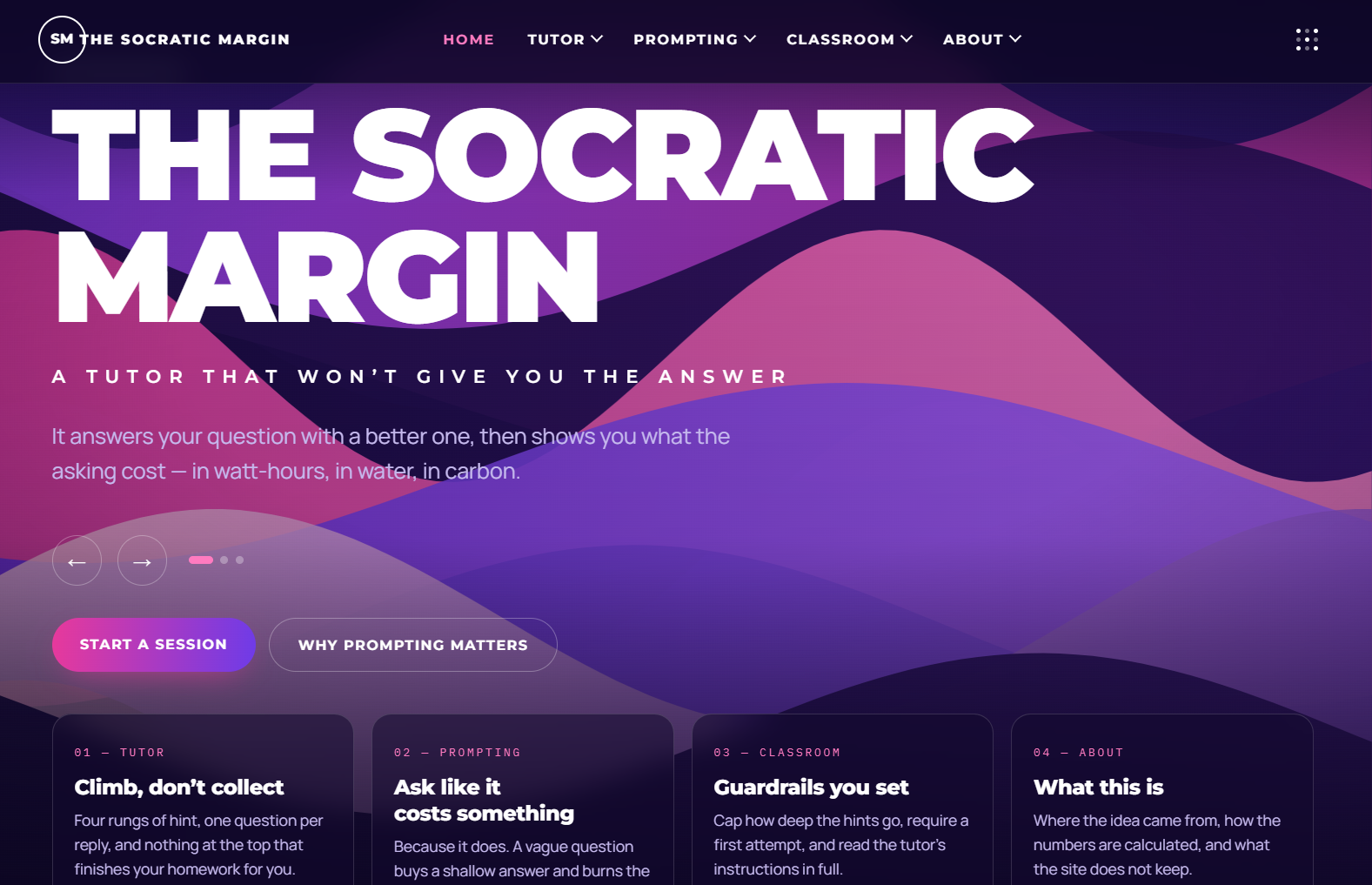
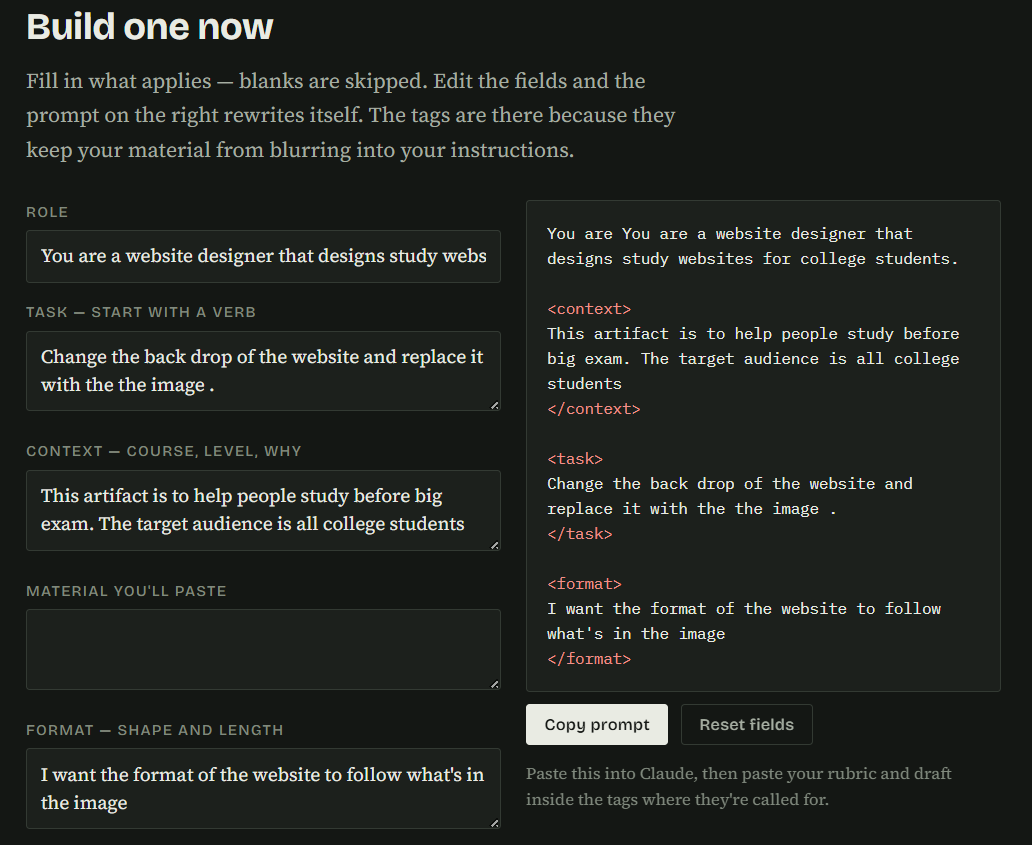
There are two different artifacts that are being displayed here which are the Socratic Margin & my Build One now prompt agent
The Socratic Margin- This a website I created through the LLM Claude. This website lets you submit any academic material and asks you three questions. What you’re working on, what you tried, and where it stops making sense. Futhermore when you submit your content it breaks down what you dont understand step by step. This website also has a drop down tab to inform everyone on why prompting matter and the importance of prompting as well.
Prompt to create website: You are a website designer that designs websites for teachers and students. Your job is to create an AI tool that acts as a tutor instead of spitting out answers.
<context>
This AI tool should be similar to (CS050) that is a generative AI used for an intro course at Harvard University
</context>
<task>
Generate an AI tool that acts as a tutor to anyone and helps them guide them to get the answer, and furthermore informs them of the importance of effectively prompting to utilize fewer resources to negate the harm to the environment)
</task>
<format>
I want this to be formatted as a website that has (colors that are visually appealing to said audience.
</format
I create this prompt through my prompting kit, which is the Build one now agent that helps you create prompt to produce the best outputs. Using what we learn from the readings on prompting.
Cituation: Ad Hoc Committee on AI Use in Teaching, Learning, and Research Training. Report of MIT’s Ad Hoc Committee on AI Use in Teaching, Learning, and Research Training. Massachusetts Institute of Technology, 13 Aug. 2026, aiandeducation.mit.edu/report/.
Anthropic. “Prompting Best Practices.” Claude Platform Docs, platform.claude.com/docs/en/build-with-claude/prompt-engineering/claude-prompting-best-practices. Accessed 20 Sept. 2026.
Declaration of AI usage:I acknowledge the use of Generative AI tools in creating these artifacts: I used Claude to write the code for both tools from my own design specifications, and both artifacts call Claude at runtime to generate the tutoring dialogue.