
Week 2 Reflection Blog Post: Data

In my small group, we discussed several topics related to the archived Wooster Voice newspaper posts. We questioned the reasoning behind these posts and how we could determine their main agenda. We also considered which issues were most relevant over 60 years ago, since concerns in the 1960s may have differed from those we face today. Finally, I wondered whether the newspaper focused more on men’s sports than women’s.

They were pretty interesting questions for our group because we didn’t know anything about life on Wooster’s campus back then, so it’s always interesting seeing what we can find!

The Wooster Voice. (2022). http://introdh.voices.wooster.edu/wp-content/uploads/sites/540/2026/08/cropped-Screen-Shot-2020-03-26-at-3.34.48-PM.png

I would organize the spreadsheet to focus on how women’s sports were represented in the Wooster Voice. Each row would represent one article or newspaper post about a women’s sports team or athlete. The columns could include the date, sport or team, article title, type of coverage, athletes mentioned, amount of coverage, tone of the article, main topic, and how women athletes were portrayed.

For controlled vocabulary, I would use consistent terms such as women’s basketball, women’s soccer, athletics, gender, achievement, competition, leadership, and academics. This would make it easier to compare articles and see how the representation of women’s sports changed over time.

I would approach data privacy by only including information that is already publicly available in the Wooster Voice archives. I would avoid collecting unnecessary personal information, such as addresses and phone numbers. Since the project focuses on multiple women’s sports and not individuals, I would limit names to athletes or coaches who are directly mentioned in the articles.
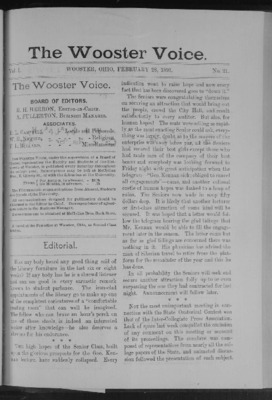

Eric S. Data Blog Post

For this blog and data questions I used the February 7th, 1891 edition of the Wooster Voice, edited by R. H. Herron and A. Fullerton. This edition was very notable as it was written shortly after the voices inception in 1883 and it is very clear that during this period, the voice was still finding its voice. Some questions that were generated from this edition were: How often were/are non standard English conventions and other languages featured in the Voice; As well as how often other colleges and universities mentioned in the voice and for what reason. These questions stemmed firstly because in the February 7th, edition, there is an entire column written in what seems to be pig latin, and there is an entire section dedicated to the happenings of other universities such as Yale, Columbia, and Dartmouth.

Editors, Wooster Voice, “The Wooster Voice (Wooster, Ohio), 1891-02-07” (1891).The Voice: 1890-1900. 18.
https://openworks.wooster.edu/voice1890-1900/18

If I were to create a data sheet, tracking how often other colleges were mentioned in the voice I would make columns for: name of college, date, create a keyword library for how they were mentioned or what they were mentioned for in simple categories(sports, student organization, staffing changes, etc.), and then a summary column quoting what they were mentioned for.

In this proposed dataset I do not think that privacy would be much of a concern as much of the information spoken about in this section does not mention specific people by name except for the case of a university hiring a new professor or president. Instead I would be very careful and diligent in my citing of each edition of the Wooster voice used in the data set.

Blog 2: Turning The Wooster Voice into Data

Some interesting questions in my group were: What is deemed important to tell the students? What topics are repeated? Who is writing/contributing the most to The Voice?

These are interesting because it gets into the reason The Voice exists, how it is used, who it is for, and if it is informative. Another significant benefit is being able to look at these records in the future, providing historical data for study.

To organize my main question of what is talked about in the voice, I would break it down:

My rows would include:

  • what week/ time the voice article I am looking at is.

What the columns would be:

  • Who is the author?
  • What is the main topic of the week?
  • Was this topic repeated in another week?
  • Is this a topic related to the school or a global event?
  • Was a day or week missed?

Some keywords would be for the rows, such as global or local, or repeated or single post. 

For data privacy, I would be sure to get permission from the authors to use their work in my studies, as their names are attached to the writing. I do have concerns about authors being targeted about topics that may be less agreed upon. The information is publicly posted already; however, if any personal information is in the writing, I would keep it vague.

Introductions & Muddy Points

I’m Anna (Annie) Henegar (she/her), a Communication major on the Public Health pathway, and I love hiking in different places around the country with hopes of exploring the world someday, going to country concerts with my friends in the summer, and playing on the Women’s Soccer team here at Wooster.

Introduction

Hey! Please call me Akua (A-kwi-yah). I am a Communications Studies major. I like photography, art, reading, writing, learning random courses and anything creative. I usually read or watch videos as a hobby! I recently watched Outer Banks again.

ELLE Magazine. (2026). Pinterest. https://www.pinterest.com/pin/317222367526315639/

My muddiest point question is: What kind of projects we can come up when we look at other peoples digital humanities projects?

Introduction & Muddy Point

Hello! My name is Adam, I use He/They pronouns, and this is my Senior year as an English Major here at Wooster.

the garfield pipe comic was in the prototype comic jon : r/TheMatpatEffect

My “muddy point” question is this; When exactly were the Digital Humanities recognized as a field? Is there even a moment that can be defined as the ‘birth’ of the study?