
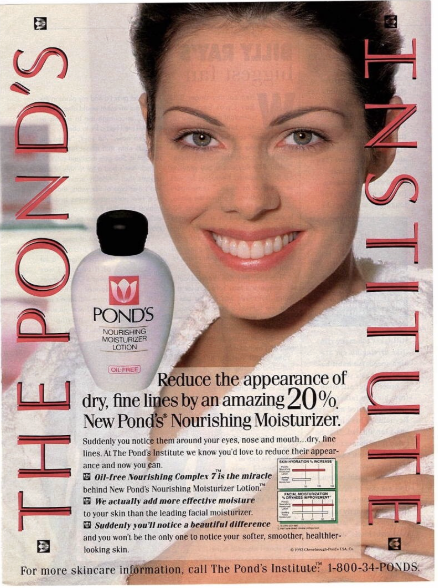
At this preliminary stage of my project, I will build a small database of facial moisturizer ads from Cosmopolitan and Essence (or Vogue), two long-running US women’s magazines, from the years 1985, 1995, 2005 and 2025. For each year, I will sample the same editions and collect maybe 5 or 10 moisturizer ads per magazine per year depending on how much is available on the archives and libraries. Each ad will be in a row, with columns for the year, magazine, the brand, who presents the product, who the audience is, health claims and scientific language. I can only document what is explicitly stated at this part of the process. I will then use Flourish to visualize the patterns over time between the two magazines and use Canva to build an exhibit that displays the ads with details, alt text and sources next to it. I will look at the patterns in my sample (the four dates) the presenters, audience, claims, language and how it has shifted over those years and what that suggests about cultural values/norms and others.
In data collection, beng ethical is one of the most important steps to carryout through a project. “When building a data set we need to consider if the source and method we’re using to collect
the information is the most accurate and complete possible” (Barr, 2021). This quote reminded me to think thoroughly about ethical areas that matter most. They would be: data collection, representation, transparency, publishing, context, community representation, accessibility and AI use. When it comes to race, gender, age, I do not want to guess out of the possibility of misrepresenting someone so, i plan to record only what an ad explicitly states or shows in caption or in sources about identity. Transparency is also an ethical area I will address. I want to document everything necessary so that anyone looking at my chart and exhibit can see everything that was done. I plan to structure the spreadsheet such that one row per ad, document my sampling method, any uncertainties or exclusions and why i chose those 4 years.
My Canva exhibit will have real ads, with real people so i ave to give context to the brands advertised. Also with Canva, I will use low resolution but clear images and write captions. Community representation depends on the magazine i use. Right now, I have decided on Essence, which was created for Black women so I want to use that history to also interpret the ads so that I can better explain the beauty standards/cultural norms. I am not trying to use one magazine as a default and the other as an exception for a race conversation.
I want to create a chart and a digital exhibit experience that is inclusive so that it “can be used by as many people as possible”(Cidoncha, 2026). To do that, there are a few things to consider and for now, I pla to add alt text to every ad and the chart, use a dark and light mode version, be mindful of colors and contrasts as well as font size and type. Also, if I use AI at any point, I will double check for facts because AI may misinterpret something about the ad or have a bias as discussed in Gender Shades. I want to do everything myself, to avoid adding to the environmental costs (especially if this is something I can do completely without AI). That is the plan but I will always disclose any AI use at the end to avoid any plagiarism concerns and transparency issues.
Credits: Barr, C. (2021). Building Your Own Data Set: Documenting Knife Crime in the United Kingdom. In L. Bounegru & J. Gray (Eds.), The Data Journalism Handbook: Towards A Critical Data Practice (pp. 49–54). Amsterdam University Press. https://doi.org/10.2307/j.ctv1qr6smr.10
Cidoncha, C. (2026). Page restricted. Iubenda.Com. https://www.iubenda.com/en/help/181591-inclusive-design/
Vintage 1990s magazine print ad the Pond’s Institute skin care Lotion Health V2. (2026, July 10). eBay. https://www.ebay.com/itm/204803412532
AI use: No AI was used to write up this blog post.
As someone in a makeup class, it is interesting to see what results you may get. I am specifically interested in what you mentioned about the health claims and the audiences it is targeted at. Many makeup or skin care companies use harmful chemicals and claim it is fine, and then market to older or younger generations without care. I am interested to see the results of who is mainly targeted.